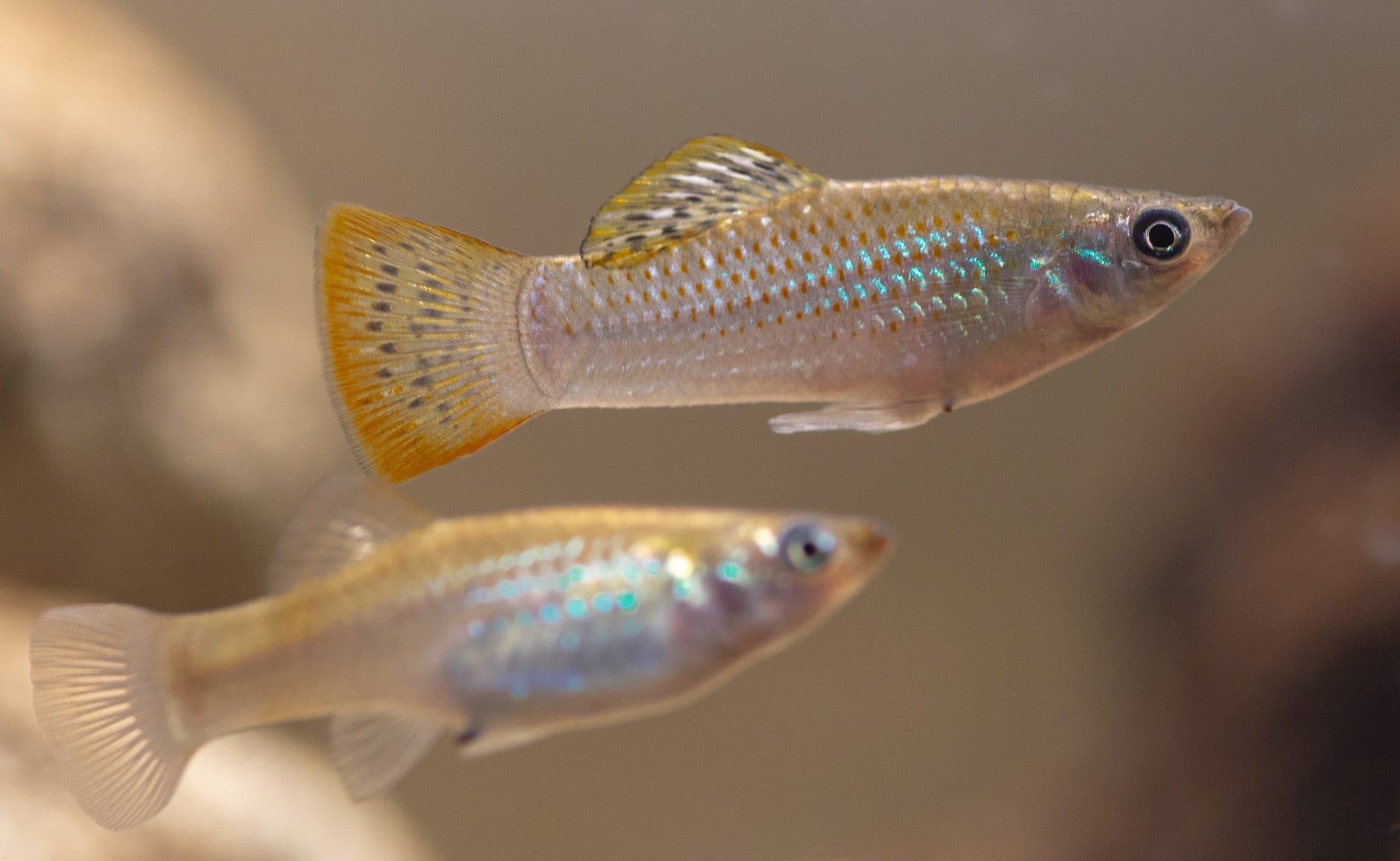
Photo: Dnoerholm, CC BY-SA 4.0, via Wikimedia Commons
Atlantic molly
Poecilia mexicana
11 cm
Adult size
180 L
Minimum volume
4
Minimum group
8 years
Lifespan
Water parameters
Understand these values- Genus
- Poecilia
- Diet
- omnivore
- Social life
- harem
In the wild
Overview
Described in 1863 by Franz Steindachner, this molly was long confused with Poecilia sphenops and was only separated from it again in 1973: its inner teeth have a single point, against three in P. sphenops. Its shape and colour vary a lot between populations.
The stockier females exceed 9 cm; the slimmer males mature at several sizes. Two populations live in caves with water laden with hydrogen sulphide, in Tabasco, and are among the best-studied cavefish. A cross between this species and another molly gave rise to the Amazon molly (P. formosa), a species made up only of females.
- Scientific name
- Poecilia mexicana Steindachner, 1863
- Classification
- Cyprinodontiformes › Poeciliidae
- IUCN Red List
- Least concern (LC)
Natural habitat
Atlantic slope of Central America, from Mexico (Río San Juan) to Guatemala, Belize and as far as Costa Rica; introduced on several Pacific islands
Observations (GBIF) and localities Native countries Rivers and lakes
It lives in shallow, calm or still water, fresh or brackish: warm springs and their outflows, canals, weedy ditches, river pools, and even the cenotes of the Yucatán.
It mainly grazes the algae and detritus covering the bottom and the plants.
Behaviour
Peaceful, it lives in groups; males compete for females without injuring each other. Keep one or two males with several females, in hard, alkaline water, with other calm fish from its habitat (swordtails, platies, small cichlids such as Thorichthys meeki).
A livebearer, the female gives birth to fully formed fry. It needs some plant food (algae, spirulina) on top of small prey.