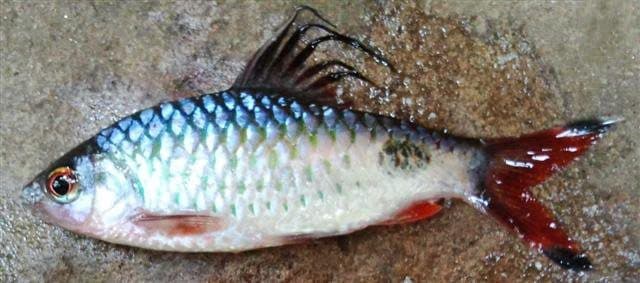
Filament barb
Dawkinsia filamentosa
12 cm
Adult size
300 L
Minimum volume
10
Minimum group
8 years
Lifespan
Water parameters
Understand these values- Genus
- Dawkinsia
- Diet
- omnivore
- Social life
- shoal
In the wild
Overview
The genus Dawkinsia, created in 2012, honours the biologist Richard Dawkins for his contribution to the public understanding of evolution. The filament barb, called poovali paral in Kerala, was described from Alleppey (Alappuzha), between Vembanad Lake and the Arabian Sea.
Juveniles are almost colourless and marked with black spots. Adults have a broad black blotch on the caudal peduncle and a black band near the tip of each tail lobe; the dorsal-fin rays of males grow into filaments, which may disappear outside the breeding season.
- Scientific name
- Dawkinsia filamentosa (Valenciennes, 1844)
- Classification
- Cypriniformes › Cyprinidae
- IUCN Red List
- Least concern (LC)
Natural habitat
Southern India: Kerala, Tamil Nadu and southern Karnataka, at the foot of the Western Ghats
Observations (GBIF) and localities Native countries Rivers and lakes
It is most common in coastal floodplains: lower river reaches, estuaries, coastal marshes and reservoirs, in fresh and brackish water. It shares these rivers with the Denison barb, the Arulius barb, the striped panchax and the Malabar pufferfish.
Very abundant during the monsoon, when the rivers flood, it feeds on worms, insects, small crustaceans and plant debris.
Behaviour
Peaceful and very active, it lives in schools: at least 8 to 10 fish, which become bolder and keep their squabbles within the group. It suits a spacious river tank with other cyprinids and loaches, but its activity can bother slow fish.
It needs clean, well-oxygenated water and a moderate current. An omnivore, it accepts dry food, to be completed with live or frozen prey.
Sources:FishBase Seriously Fish GBIF · Base map: Natural Earth