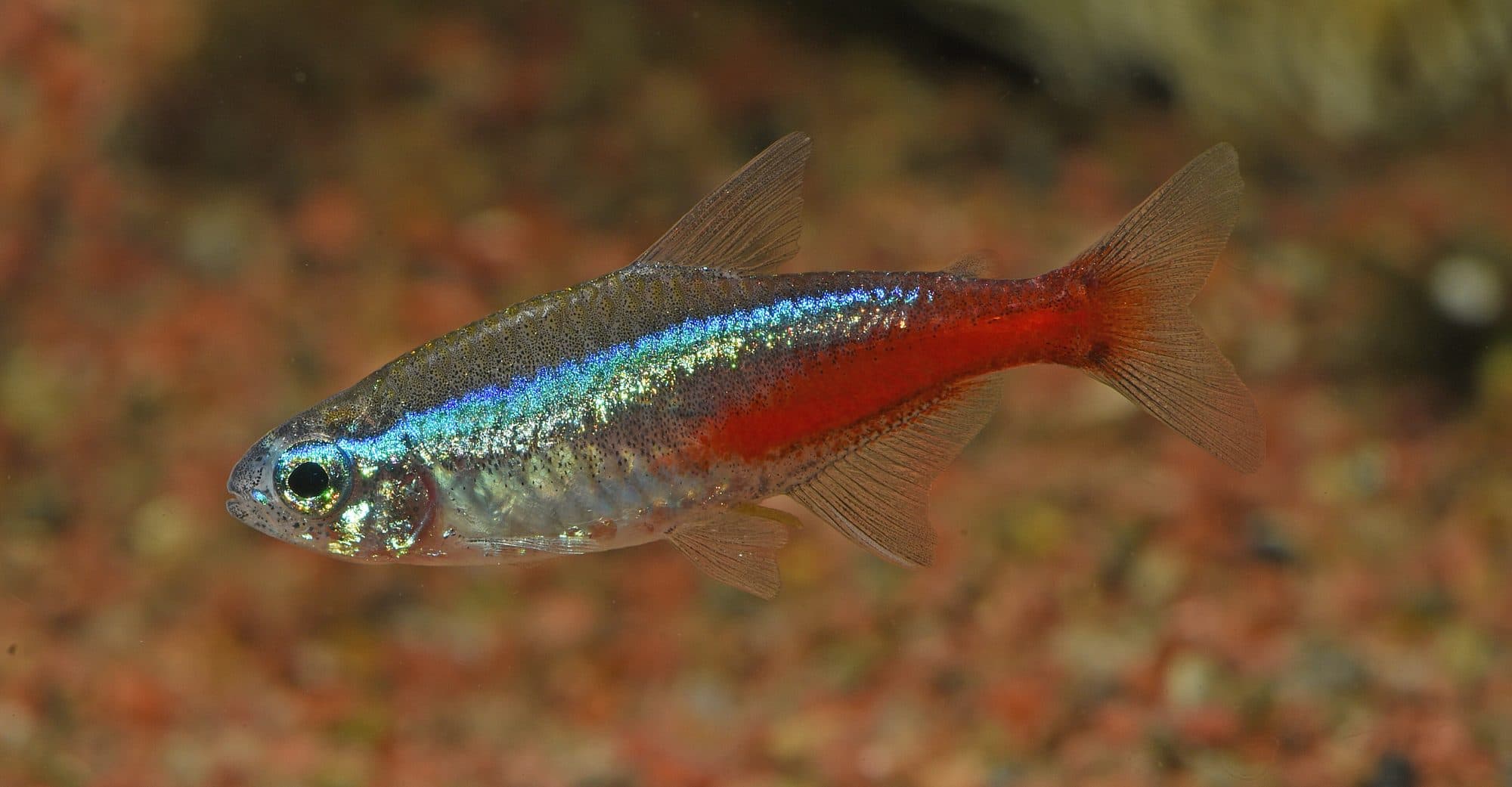
Photo: SOK, CC BY-SA 4.0, via Wikimedia Commons
Neon tetra
Paracheirodon innesi
3 cm
Adult size
80 L
Minimum volume
10
Minimum group
5 years
Lifespan
Water parameters
Understand these values- Genus
- Paracheirodon
- Diet
- carnivore
- Social life
- shoal
In the wild
Overview
The neon tetra was described in 1936 by the American ichthyologist George S. Myers, from fish that arrived through the aquarium trade. Its name honours William T. Innes, an American aquarist, photographer and publisher who did much to popularise the freshwater aquarium.
It is one of the best-selling aquarium fish in the world; the vast majority now come from fish farms. It is particularly susceptible to “neon tetra disease”, caused by a microsporidian (Pleistophora hyphessobryconis) that can affect other species and is practically incurable once advanced.
- Scientific name
- Paracheirodon innesi (Myers, 1936)
- Classification
- Characiformes › Acestrorhamphidae
- IUCN Red List
- Least concern (LC)
Natural habitat
Upper Amazon (Rio Solimões): Leticia–Tabatinga, Codajás and Rio Purus regions (Peru, Colombia, Brazil)
Observations (GBIF) and localities Native countries Rivers and lakes
The type locality originally given, “near Iquitos” in Peru, was based on imported fish, and the true extent of its range remains poorly known. Confirmed records are concentrated around Leticia and Tabatinga (the “triple border”, with the lower Río Putumayo), then further east around Codajás and the Rio Purus.
It lives in forest streams and small tributaries rather than in the large whitewater channels. The water there is acidic, very soft, black or clear, over branches, roots and leaf litter, sometimes with aquatic plants.
Behaviour
Peaceful and gregarious, it lives in shoals in the middle water layer and feeds on worms, small insects, crustaceans and plant matter. It is kept in a group of at least 8 to 10, with fish of similar size.
It likes slightly cooler water than the cardinal (20 to 26 °C). In the aquarium the female lays a fairly small number of eggs among fine vegetation, ideally in very dim light; the eggs hatch in about a day.
Sources:FishBase Seriously Fish GBIF · Base map: Natural Earth