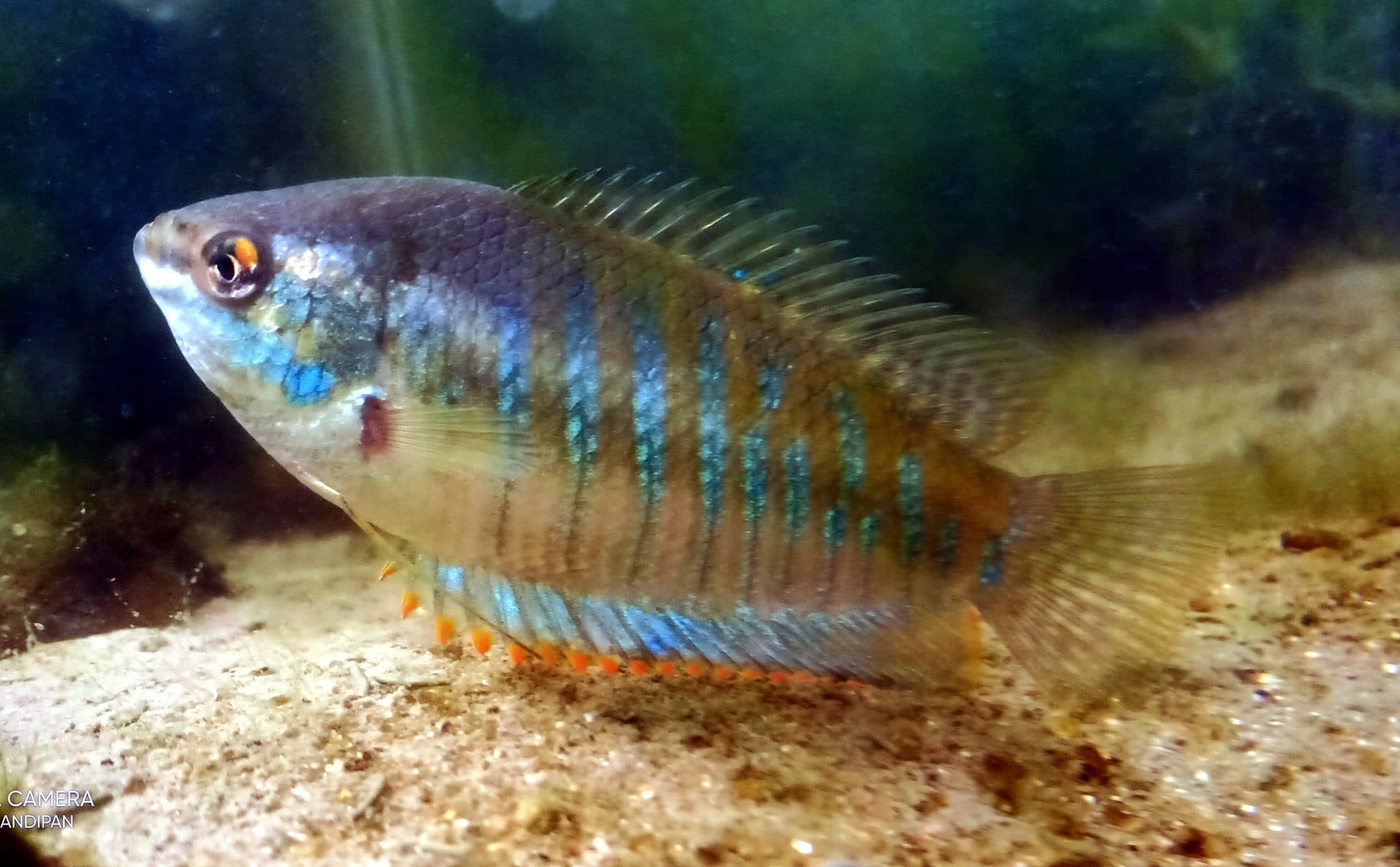
Photo: Sandipan Das, CC BY 4.0, via Wikimedia Commons
Banded gourami
Trichogaster fasciata
10 cm
Adult size
180 L
Minimum volume
2
Minimum group
8 years
Lifespan
Water parameters
Understand these values- Genus
- Trichogaster
- Diet
- omnivore
- Social life
- pair
In the wild
Overview
The banded gourami, the largest in its genus, is eaten in its native range. Beautiful and peaceful, it is nevertheless seldom seen in the trade. Like other anabantoids, it has a labyrinth organ that lets it breathe air at the surface; several colour forms are said to exist depending on locality.
- Scientific name
- Trichogaster fasciata Bloch & Schneider, 1801
- Classification
- Anabantiformes › Osphronemidae
- IUCN Red List
- Least concern (LC)
Natural habitat
Pakistan, India, Nepal, Bangladesh and upper Myanmar
Observations (GBIF) and localities Native countries Rivers and lakes
It lives in slow water, usually covered with floating vegetation: large rivers, estuaries, ditches, pools and lakes. It has been introduced to rice paddies in many regions.
Behaviour
It suits most peaceful community tanks, but can be a little aggressive when breeding, and males fight in a small tank. Keep it with peaceful species that do not look too much like it: shoals of Rasbora, Danio and barbs, loaches, small Bagridae. Not with the thick-lipped gourami, with which it hybridises. An undemanding omnivore, with live or frozen prey.
Sources:FishBase Seriously Fish GBIF · Base map: Natural Earth