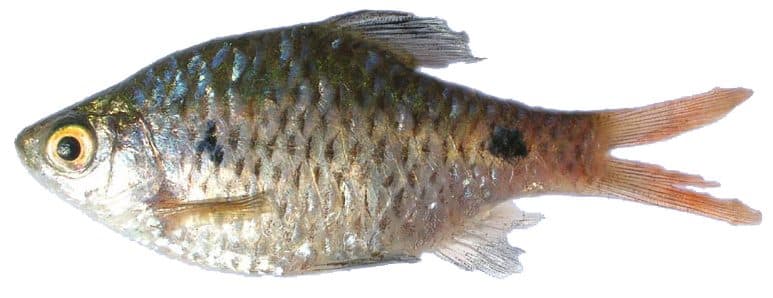
Photo: Nilesh Heda, Public domain, via Wikimedia Commons
Ticto barb
Pethia ticto
6.5 cm
Adult size
90 L
Minimum volume
8
Minimum group
5 years
Lifespan
Water parameters
Understand these values- Genus
- Pethia
- Diet
- omnivore
- Social life
- shoal
In the wild
Overview
The ticto barb, silvery with two black spots, is often confused in aquarium literature with P. padamya (Odessa barb), which is nevertheless easy to tell apart: P. ticto is far less colourful and its males have no orange-red on the body. It tolerates fairly cool water.
- Scientific name
- Pethia ticto (Hamilton, 1822)
- Classification
- Cypriniformes › Cyprinidae
- IUCN Red List
- Least concern (LC)
Natural habitat
Indian subcontinent: Pakistan, India, Nepal, Bhutan, Bangladesh and Sri Lanka; records from Myanmar and China remain to be confirmed
Observations (GBIF) and localities Native countries Rivers and lakes
It is especially abundant in shallow streams and small tributaries, sometimes at altitude, over mud or silt, and in the calm margins of reservoirs and rivers, where it forages near the bottom. The female lays about 150 eggs in batches of around twenty.
Behaviour
Very peaceful, ideal in a well-planned community tank, ideally with midwater cyprinids of similar size, loaches or bottom-dwelling cyprinids (Crossocheilus, Garra). A mixed group of at least 8 to 10 is needed, in which males compete harmlessly. A foraging omnivore: dry food with a plant component and small live or frozen prey.
Sources:FishBase Seriously Fish GBIF · Base map: Natural Earth