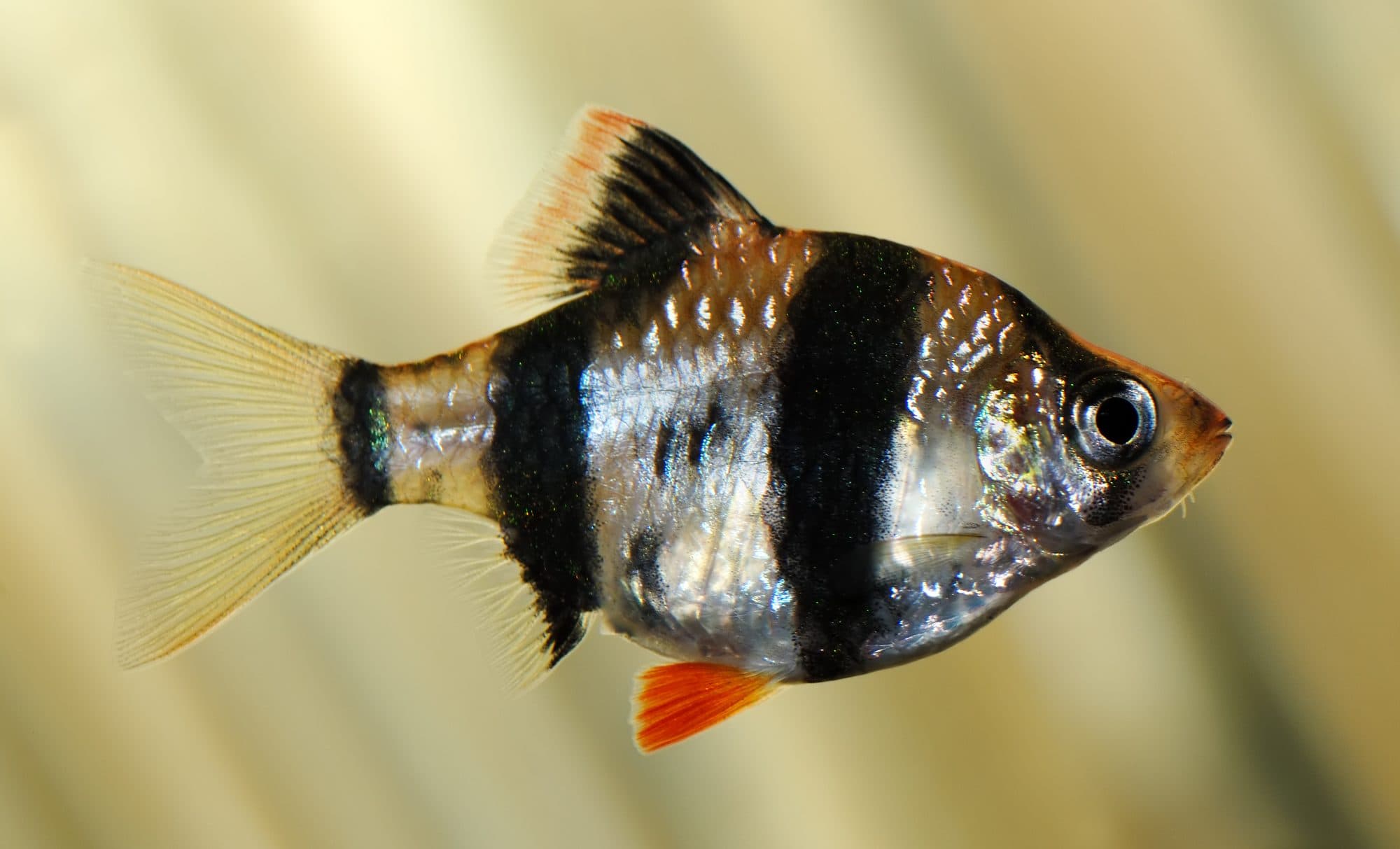
Photo: André Karwath aka Aka, CC BY-SA 2.5, via Wikimedia Commons
Tiger barb
Puntigrus tetrazona
7 cm
Adult size
80 L
Minimum volume
6
Minimum group
5 years
Lifespan
Water parameters
Understand these values- Genus
- Puntigrus
- Diet
- omnivore
- Social life
- small group
In the wild
Overview
Described in 1855 by the Dutch physician and ichthyologist Pieter Bleeker, the tiger barb owes its name tetrazona (“four bands”) to the four broad black vertical bands across its golden body. The genus Puntigrus, created in 2016, combines Puntius and tigris (“tiger”).
Records from Borneo actually refer to related species. Very widespread in the hobby, it suffers from heavy inbreeding in some farms, and it is among the species subjected to the cruel practice of artificial colouring by injection.
- Scientific name
- Puntigrus tetrazona (Bleeker, 1855)
- Classification
- Cypriniformes › Cyprinidae
- IUCN Red List
- Least concern (LC)
Natural habitat
Central and southern Sumatra (Indonesia); introduced populations in many countries
Observations (GBIF) and localities Native countries Rivers and lakes
The species is thought to be endemic to central and southern Sumatra, with records from the Indragiri, Batang Hari and Musi river basins; the type locality is Lahat, in South Sumatra province. Populations from aquariums have become established in Singapore, Australia, the United States, Colombia and Suriname.
Its exact habitat is not confirmed; its Bornean cousins live in clear-water forest streams over sand and pebbles, between 20 and 26 °C.
Behaviour
Lively and boisterous, it is known for nipping other fish's fins, especially if there are too few of them or they are cramped. It forms loose hierarchies in which males constantly provoke each other: a group of at least 8 to 10 keeps these contests within the species.
Avoid it with slow, shy or long-finned fish (guppies, angelfish, gouramis, bettas). An omnivore, it feeds mainly on aquatic invertebrates, supplemented with plant matter. An egg scatterer, it gives no parental care.
Sources:FishBase Seriously Fish GBIF · Base map: Natural Earth