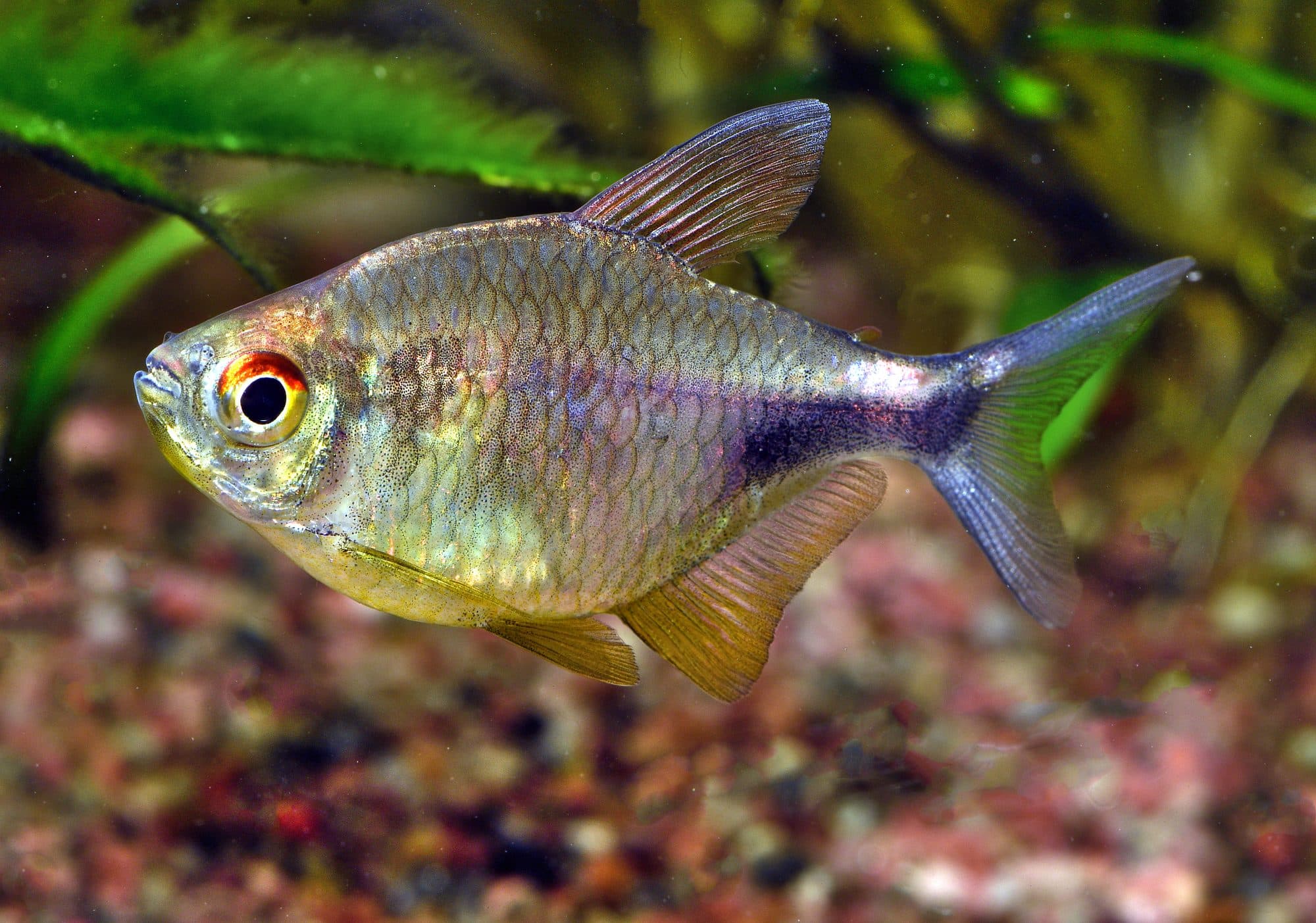
Photo: SOK, CC BY-SA 4.0, via Wikimedia Commons
Garnet tetra
Hemigrammus pulcher
4 cm
Adult size
80 L
Minimum volume
10
Minimum group
5 years
Lifespan
Water parameters
Understand these values- Genus
- Hemigrammus
- Diet
- omnivore
- Social life
- shoal
In the wild
Overview
Described in 1938 by the German ichthyologist Werner Ladiges, pulcher means “beautiful” in Latin. This tetra is recognised by the crescent-shaped black blotch on the rear of its body, topped by a coppery area, and by the red on the upper part of its eye. FishBase now places it in the genus Holopristis, as Holopristis pulchra.
Most fish sold in Europe come from fish farms in Eastern Europe. Beware: the name “diamond tetra” usually refers to another species, Moenkhausia pittieri.
- Scientific name
- Holopristis pulchra (Ladiges, 1938)Current valid name; in the hobby: Hemigrammus pulcher
- Classification
- Characiformes › Acestrorhamphidae
- IUCN Red List
- Least concern (LC)
Natural habitat
Upper Peruvian Amazon
Observations (GBIF) and localities Native countries Rivers and lakes
Endemic to the upper Amazon basin in Peru, it lives in slow tributaries of large rivers, usually under forest cover.
The water there is tropical (23 to 27 °C), soft and acidic.
Behaviour
Lively and peaceful, it fits well into most community aquariums: other tetras, rasboras, danios, livebearers, corydoras and small loricariids. Rather shy, it should not live with much larger or boisterous fish.
A shoaling fish, it is kept in a group of at least 6, ideally 10. It breeds fairly easily in a separate tank: spawning takes place among plants and the eggs hatch in 20 to 24 hours. The sexes are told apart by the swim bladder, visible through the body: pointed in the male, rounded in the female.
Sources:FishBase Seriously Fish GBIF · Base map: Natural Earth