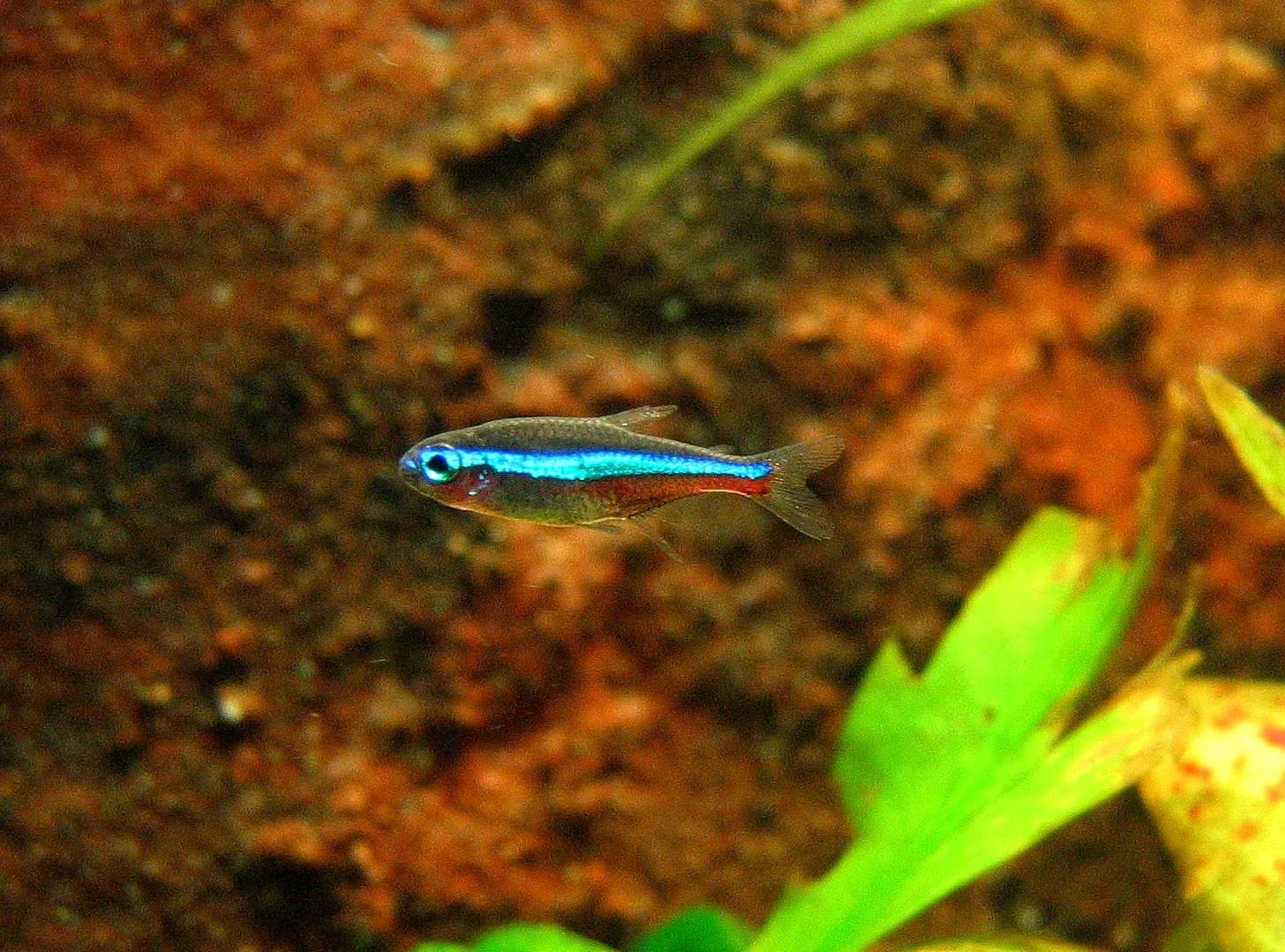
Photo: Sascha Biedermann, CC BY-SA 2.5, via Wikimedia Commons
Green neon tetra
Paracheirodon simulans
2 cm
Adult size
80 L
Minimum volume
10
Minimum group
5 years
Lifespan
Water parameters
Understand these values- Genus
- Paracheirodon
- Diet
- carnivore
- Social life
- shoal
In the wild
Overview
Described in 1963 by the French ichthyologist Jacques Géry, the green neon owes its Latin name simulans (“imitating”) to its resemblance to the neon and cardinal tetras. It is the smallest of the three Paracheirodon: it rarely exceeds 2.5 cm. Its blue-green band extends to the tail, but the red is limited to the rear of the belly.
The type locality first published (“Rio Purus, Manaus”) was wrong and has been corrected to the Rio Jufaris, a tributary of the Rio Negro. Some wild individuals have golden scales and are sold as “platinum”: this sheen is thought to be caused by a parasite that stimulates guanine deposits in the scales.
- Scientific name
- Paracheirodon simulans (Géry, 1963)
- Classification
- Characiformes › Acestrorhamphidae
- IUCN Red List
- Least concern (LC)
Natural habitat
Middle and upper Rio Negro above the Rio Branco, and Orinoco on the Venezuela–Colombia border
Observations (GBIF) and localities Native countries Rivers and lakes
Unlike the neon and cardinal, it lives only in black water, in the upper parts of tributaries draining terra firme forest. These streams have a slow to moderate current, banks covered in vegetation and a sandy bottom strewn with branches, roots and dead leaves. The water is very acidic, almost free of minerals and stained by humic acids.
Although it partly shares the range of the cardinal, the two species do not occur in the same streams; the green neon generally occupies warmer water.
Behaviour
Peaceful but tiny and demanding about water quality, it is best suited to a species tank or one shared with very small, calm fish (small characins, dwarf corydoras). Gregarious, it forms shoals: a group of at least 8 to 10 makes it less fearful.
It is not bred commercially; the fish sold are wild-caught, which makes it rarer and more expensive than its cousins. Adult females are recognised by their rounder belly.
Sources:FishBase Seriously Fish GBIF · Base map: Natural Earth