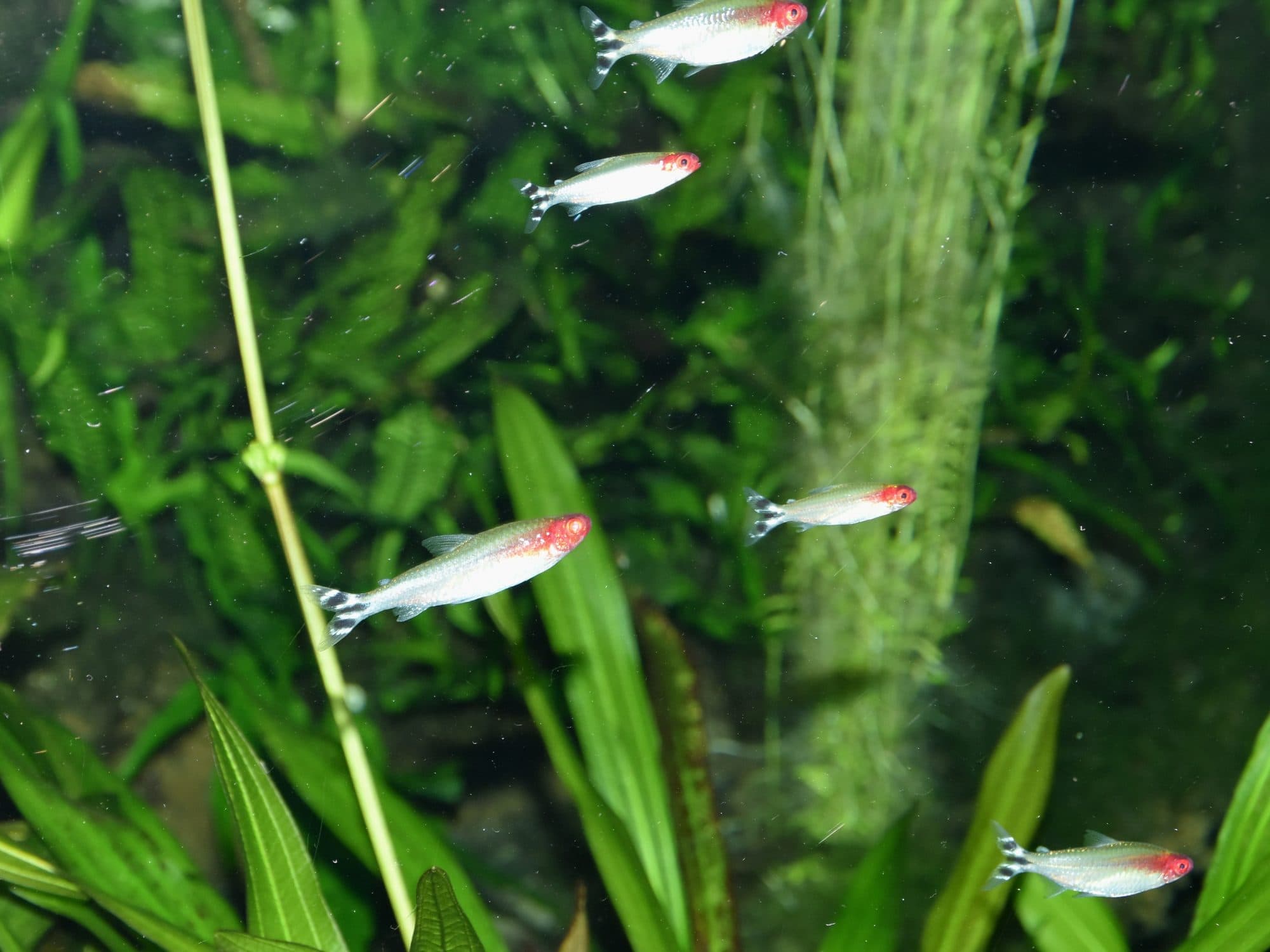
Photo: NasserHalaweh, CC BY-SA 4.0, via Wikimedia Commons
False rummy-nose tetra
Petitella georgiae
5 cm
Adult size
160 L
Minimum volume
10
Minimum group
6 years
Lifespan
Water parameters
Understand these values- Genus
- Petitella
- Diet
- carnivore, herbivore and planktivore
- Social life
- shoal
In the wild
Overview
Described in 1964 by Jacques Géry and Henri Boutière, the false rummy-nose is the type species of the genus Petitella, named after the French zoologist Georges Petit (1892–1973); the species name honours Georgie, Géry's wife.
It looks very much like the two other “rummy-noses” (Hemigrammus rhodostomus and Petitella bleheri). It is recognised by the absence of a dark spot under the caudal peduncle and by the broad black band that extends the tail's central stripe into the body.
- Scientific name
- Petitella georgiae Géry & Boutière, 1964
- Classification
- Characiformes › Acestrorhamphidae
- IUCN Red List
- Least concern (LC)
Natural habitat
Upper Amazon in Peru, Purus, Negro and Madeira basins in Brazil
Observations (GBIF) and localities Native countries Rivers and lakes
It is native to the upper Amazon basin in Peru and the Purus, Negro and Madeira basins in Brazil.
It lives mainly in clear-water tributaries and small rivers, at 22 to 26 °C, in soft, slightly acidic water.
Behaviour
Very peaceful, it forms one of the tightest shoals among small tetras: at least ten are needed, more if possible, for it to feel safe. It does not tolerate boisterous or much larger companions.
Its tiny mouth calls for fine food: worms, small crustaceans and plant matter in the wild, small live prey and crushed dry food in the aquarium. Its breeding in captivity is said to be tricky; mature females have a rounder body.
Sources:FishBase Seriously Fish GBIF · Base map: Natural Earth