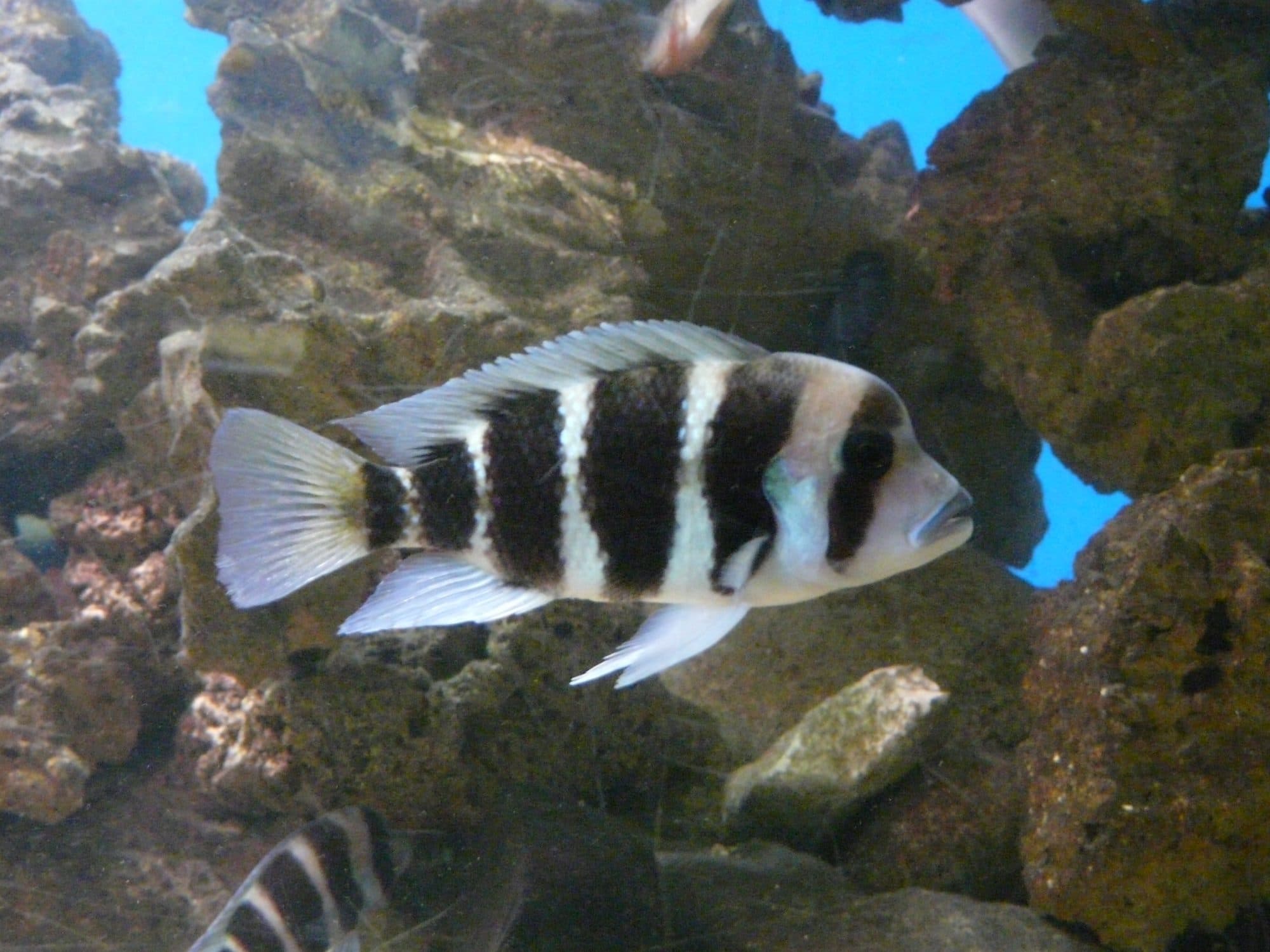
Photo: Père Igor, CC BY-SA 3.0, via Wikimedia Commons
Frontosa
Cyphotilapia frontosa
25.5 cm
Adult size
1100 L
Minimum volume
5
Minimum group
12 years
Lifespan
Water parameters
Understand these values- Genus
- Cyphotilapia
- Diet
- carnivore
- Social life
- small group
In the wild
Overview
The frontosa owes its name to the frontal hump of adults and its genus to the Greek word for “hump”. Populations are sold under their locality names to keep the lines pure; most have six vertical bands, except the Kigoma form, which has seven.
- Scientific name
- Cyphotilapia frontosa (Boulenger, 1906)
- Classification
- Cichliformes › Cichlidae
- IUCN Red List
- Near threatened (NT)
Natural habitat
Endemic to the northern half of Lake Tanganyika
Observations (GBIF) and localities Native countries Rivers and lakes
Lake Tanganyika, the oldest of the great Rift lakes, is home to about 250 endemic cichlids. The frontosa lives there over rocky, sediment-rich bottoms, between 6 and 120 m deep, mostly between 15 and 70 m.
Behaviour
It can eat much smaller fish, but fits into a selected Tanganyikan community in a very large aquarium. Gregarious, it is kept in a group of at least five, ideally ten; males form a hierarchy rather than territories. A generalist predator, it eats fish, invertebrates and molluscs; females brood the eggs in their mouths.
Sources:FishBase Seriously Fish GBIF · Base map: Natural Earth