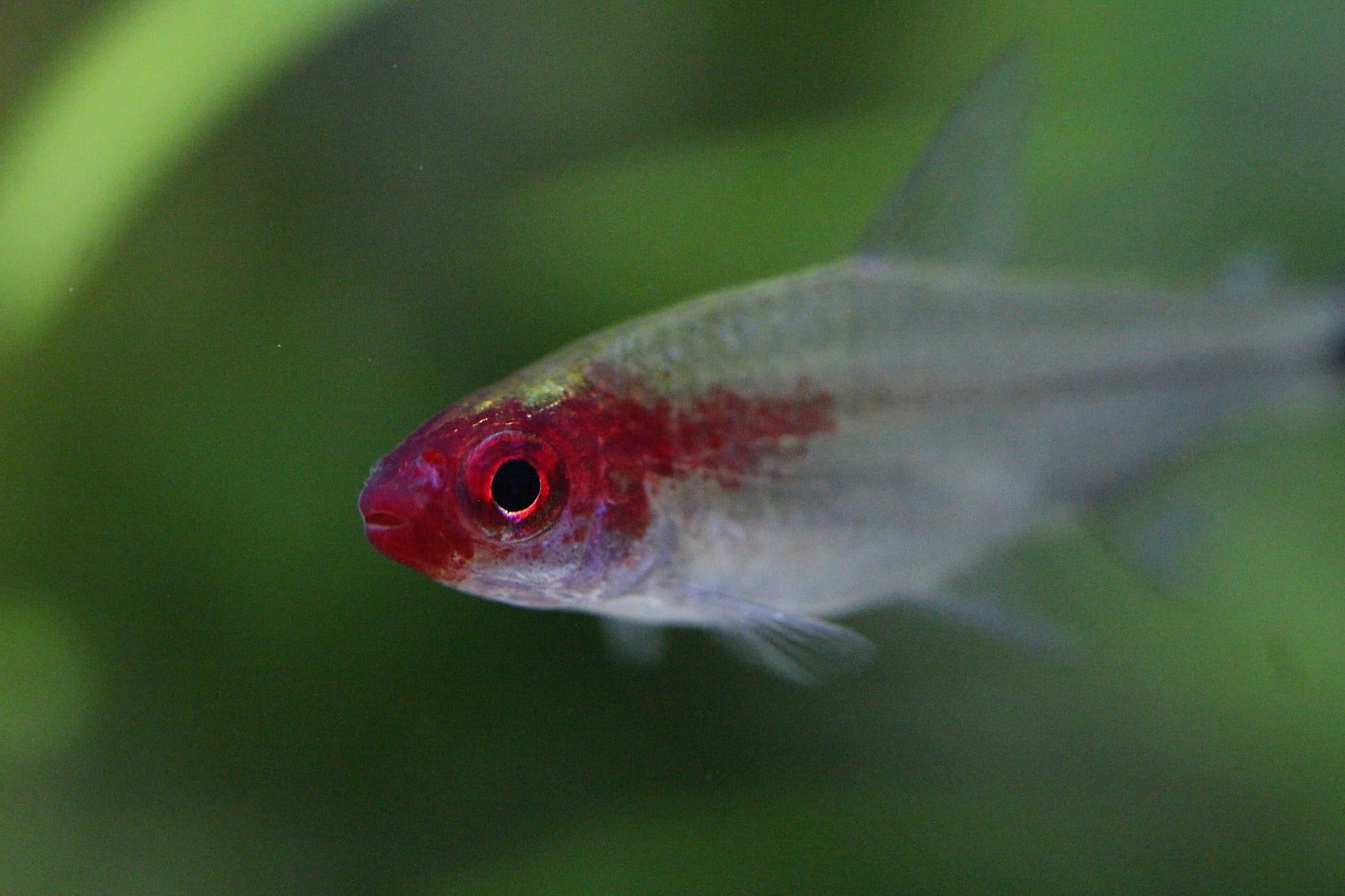
Photo: -serwacy01-, CC BY-SA 4.0, via Wikimedia Commons
Firehead tetra
Hemigrammus bleheri
5 cm
Adult size
120 L
Minimum volume
10
Minimum group
4 years
Lifespan
Water parameters
Understand these values- Genus
- Hemigrammus
- Diet
- carnivore
- Social life
- shoal
In the wild
Overview
Described in 1986 by Jacques Géry and Volker Mahnert, this rummy-nose tetra is named after Heiko Bleher, the aquarist and explorer who discovered it. Its bright red head and black-and-white striped tail make it easy to spot; FishBase now places it in the genus Petitella, named after the French zoologist Georges Petit.
Three very similar species are sold as “rummy-nose tetras”: H. rhodostomus, Petitella georgiae and this one. They are told apart by the spots on the caudal peduncle and by the band extending the tail's central stripe into the body, almost absent here.
- Scientific name
- Petitella bleheri (Géry & Mahnert, 1986)Current valid name; in the hobby: Hemigrammus bleheri
- Classification
- Characiformes › Acestrorhamphidae
- IUCN Red List
- Least concern (LC)
Natural habitat
Rio Negro and Río Meta basins (Brazil, Colombia)
Observations (GBIF) and localities Native countries Rivers and lakes
It lives in blackwater rivers and tributaries of the Rio Negro and Río Meta basins, in Brazil and Colombia.
The water there is stained brown by tannins released by decaying organic matter and is therefore very acidic and low in minerals.
Behaviour
Very peaceful, it is one of the small tetras that form the tightest shoals: it should be kept in a group of at least 10, more if possible. It copes poorly with boisterous companions and often accompanies discus in blackwater aquariums.
An omnivore with a small mouth, it accepts flakes, granules and small live or frozen prey. Mature females are rounder; its adhesive eggs are laid among fine-leaved vegetation.
Sources:FishBase Seriously Fish GBIF · Base map: Natural Earth