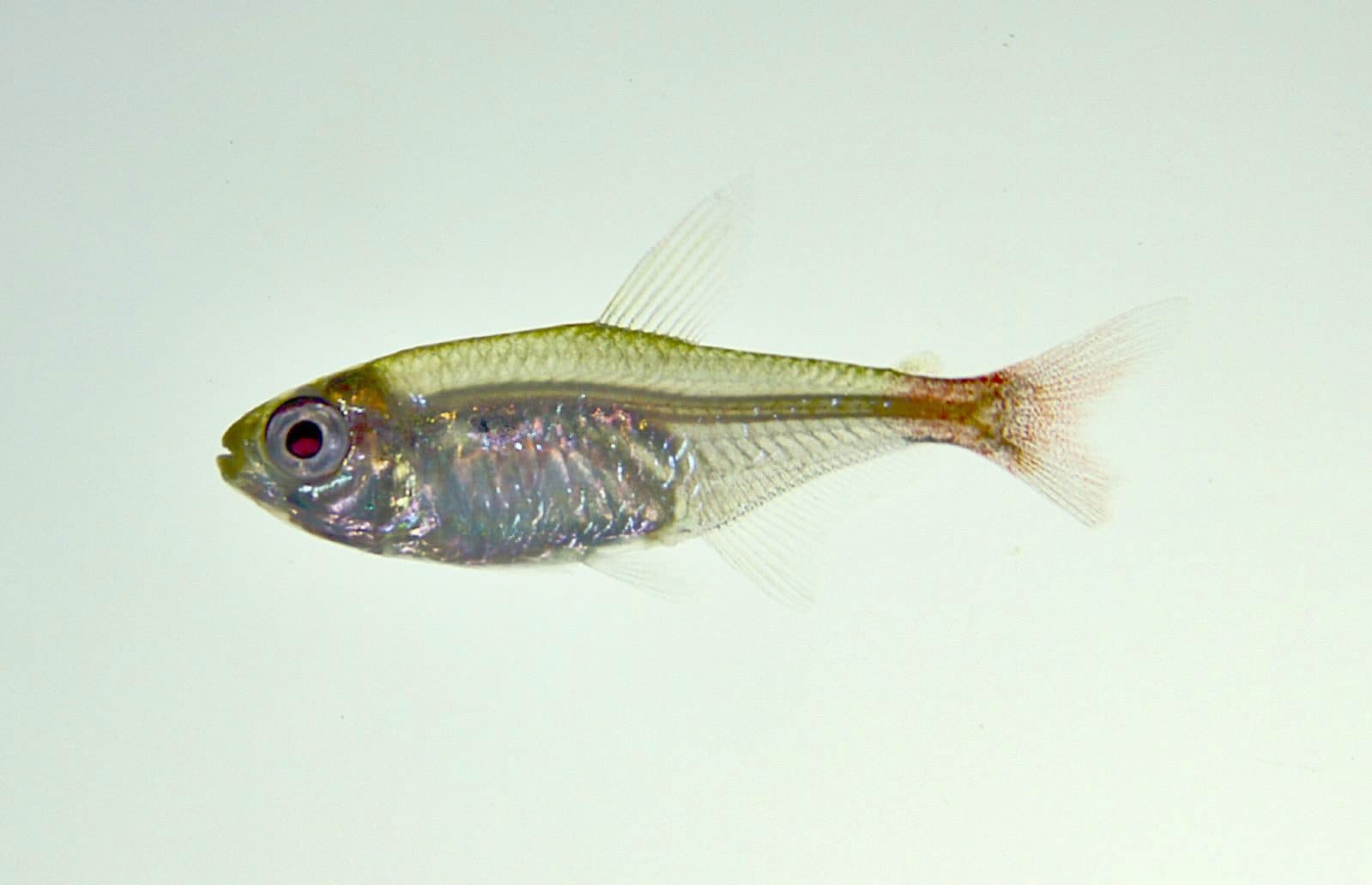
Photo: Clinton & Charles Robertson, CC BY 2.0, via Wikimedia Commons
Red-base tetra
Hemigrammus stictus
4 cm
Adult size
100 L
Minimum volume
10
Minimum group
4 years
Lifespan
Water parameters
Understand these values- Genus
- Hemigrammus
- Diet
- omnivore
- Social life
- shoal
In the wild
Overview
Described in 1909 by Marion Durbin, the red-base tetra is recognised by the bright red at the base of its tail, dorsal and anal fins, on a silvery body. The classification revised in 2024 places the genus Hemigrammus in the family Acestrorhamphidae.
Its maximum size is debated: FishBase gives 4.3 cm total length, some authors cite up to 6 cm.
- Scientific name
- Hemigrammus stictus (Durbin, 1909)
- Classification
- Characiformes › Acestrorhamphidae
- IUCN Red List
- Least concern (LC)
Natural habitat
Amazon, Rio Negro and Orinoco basins, coastal rivers of Guyana (Brazil, Venezuela, Guyana)
Observations (GBIF) and localities Native countries Rivers and lakes
It is widespread in the Amazon basin, the Rio Negro, the Orinoco and the coastal rivers of Guyana. It lives in slow rivers, tributaries and floodplain lakes.
The water there is tropical (23 to 27 °C), rather soft and slightly acidic.
Behaviour
Very peaceful, it cannot compete with boisterous or much larger companions. It lives well with other tetras, pencilfish, dwarf cichlids, corydoras and small loricariids.
A shoaling fish, it is kept in a group of at least 6, ideally 10. It feeds on small invertebrates and is not fussy in the aquarium. Adult males are slightly smaller and slimmer than females.
Sources:FishBase Seriously Fish GBIF · Base map: Natural Earth