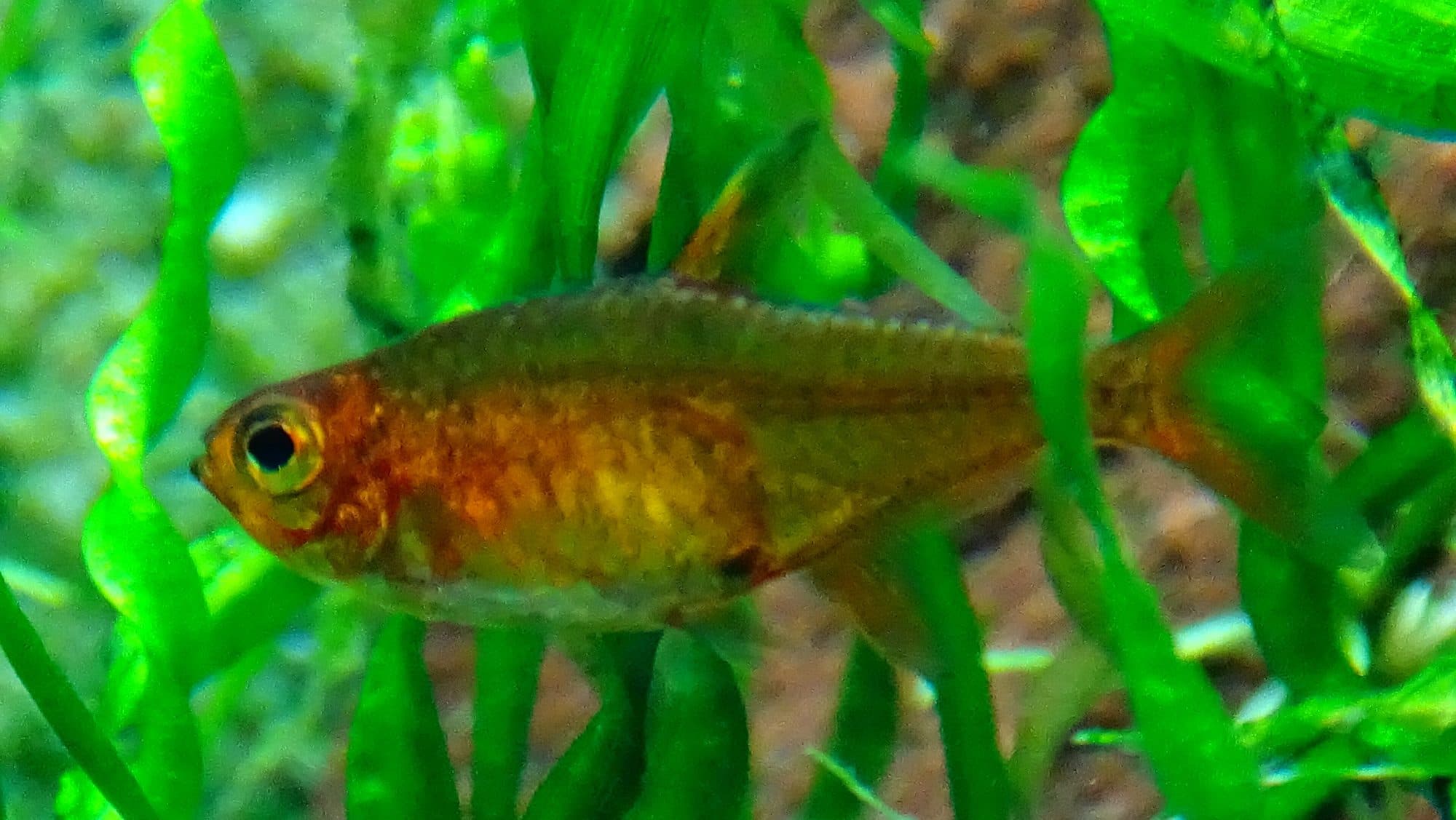
Photo: Cedricguppy - Loury Cédric, CC BY-SA 4.0, via Wikimedia Commons
Ember tetra
Hyphessobrycon amandae
3 cm
Adult size
60 L
Minimum volume
10
Minimum group
4 years
Lifespan
Water parameters
Understand these values- Genus
- Hyphessobrycon
- Diet
- omnivore
- Social life
- shoal
In the wild
Overview
Described in 1987 by Jacques Géry and André Uj, the ember tetra honours Amanda Bleher, mother of the explorer and aquarist Heiko Bleher, who took part in its discovery. It is one of the smallest Hyphessobrycon: about 2 cm without the tail.
It is also sold as the “dwarf red tetra” or “fire tetra”, referring to its bright orange colour.
- Scientific name
- Hyphessobrycon amandae Géry & Uj, 1987
- Classification
- Characiformes › Acestrorhamphidae
- IUCN Red List
- Least concern (LC)
Natural habitat
Rio Araguaia basin, central Brazil
Observations (GBIF) and localities Native countries Rivers and lakes
It is native to the Rio Araguaia basin, a large tributary of the Tocantins in central Brazil. Field information is scarce, but it probably lives in small tributaries, oxbows and meander lakes rather than in the main channels.
In the Araguaia, these habitats have soft, slightly acidic water, with a bottom covered in leaf litter and branches.
Behaviour
Very peaceful, it copes poorly with boisterous or much larger companions. It swims in the middle and upper layers of the water and does not hunt fry, which makes it an excellent “dither fish” for dwarf cichlids such as Apistogramma.
A micropredator, it feeds on tiny invertebrates and zooplankton: in the aquarium it accepts small dry food but benefits from brine shrimp or moina nauplii. A shoal of at least 8 to 10 makes it less fearful.
Sources:FishBase Seriously Fish GBIF · Base map: Natural Earth