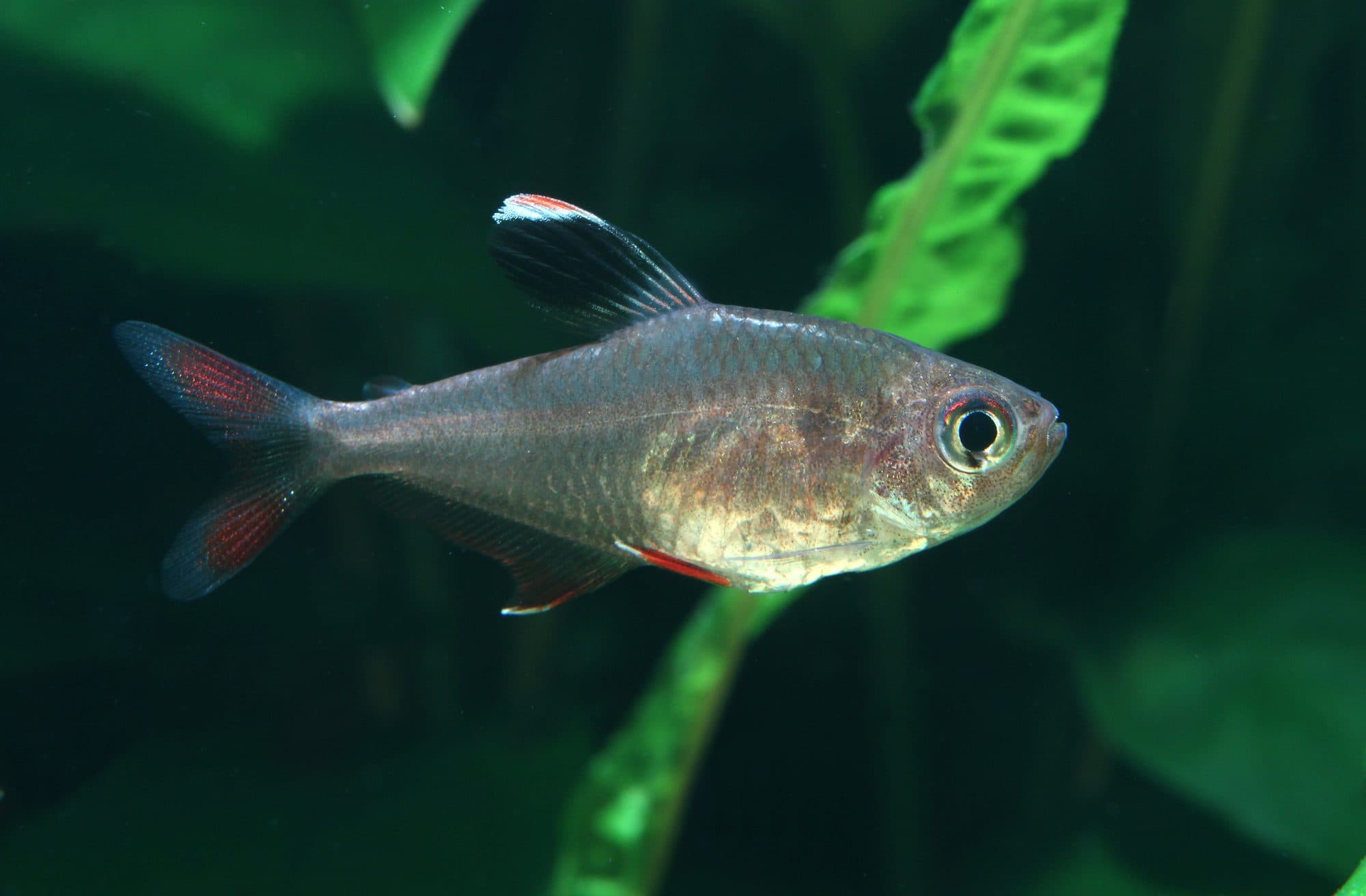
Photo: Holger Krisp, CC BY 3.0, via Wikimedia Commons
Ornate tetra
Hyphessobrycon bentosi
4 cm
Adult size
100 L
Minimum volume
10
Minimum group
5 years
Lifespan
Water parameters
Understand these values- Genus
- Hyphessobrycon
- Diet
- carnivore
- Social life
- shoal
In the wild
Overview
Described in 1908 by the American ichthyologist Marion Durbin, the rosy tetra is named after Colonel Bentos, a volunteer on Louis Agassiz's Thayer Expedition to Brazil (1865–1866), during which the type specimens were collected. The classification revised in 2024 places it in the genus Megalamphodus.
It belongs to the “rosy tetra clade” defined by Weitzman and Palmer in 1997: a pink to reddish body, a dark spot on the dorsal fin and elongated fins in males.
- Scientific name
- Megalamphodus bentosi (Durbin, 1908)Current valid name; in the hobby: Hyphessobrycon bentosi
- Classification
- Characiformes › Acestrorhamphidae
- IUCN Red List
- Least concern (LC)
Natural habitat
Amazon basin (Brazil, Colombia, Peru); type locality at Óbidos, Pará
Observations (GBIF) and localities Native countries Rivers and lakes
Its type locality lies on the main channel of the Amazon at Óbidos, between the mouths of the Trombetas and Tapajós rivers, and the species is reported from the Amazon basin in Brazil, Colombia and Peru.
Like related tetras, it mainly frequents slow tributaries, side channels and forest lakes, near roots, fallen branches, bank vegetation and aquatic plants. The water there is very low in minerals, weakly buffered and stained brown by tannins.
Behaviour
Very peaceful, it forms temporary hierarchies in which males compete for the females' attention by spreading their dorsal and anal fins. A mixed group of at least 8 to 10 shows this behaviour and better colours.
An omnivore, it accepts a varied diet (small invertebrates, crustaceans, algae). An egg scatterer with no parental care, it often spawns when in good condition. Males are slimmer, slightly smaller and more colourful than females.
Sources:FishBase Seriously Fish GBIF · Base map: Natural Earth