Scarlet badis
Dario dario
2 cm
Adult size
30 L
Minimum volume
2
Minimum group
6 years
Lifespan
Water parameters
Understand these values- Genus
- Dario
- Diet
- carnivore and planktivore
- Social life
- pair
In the wild
Overview
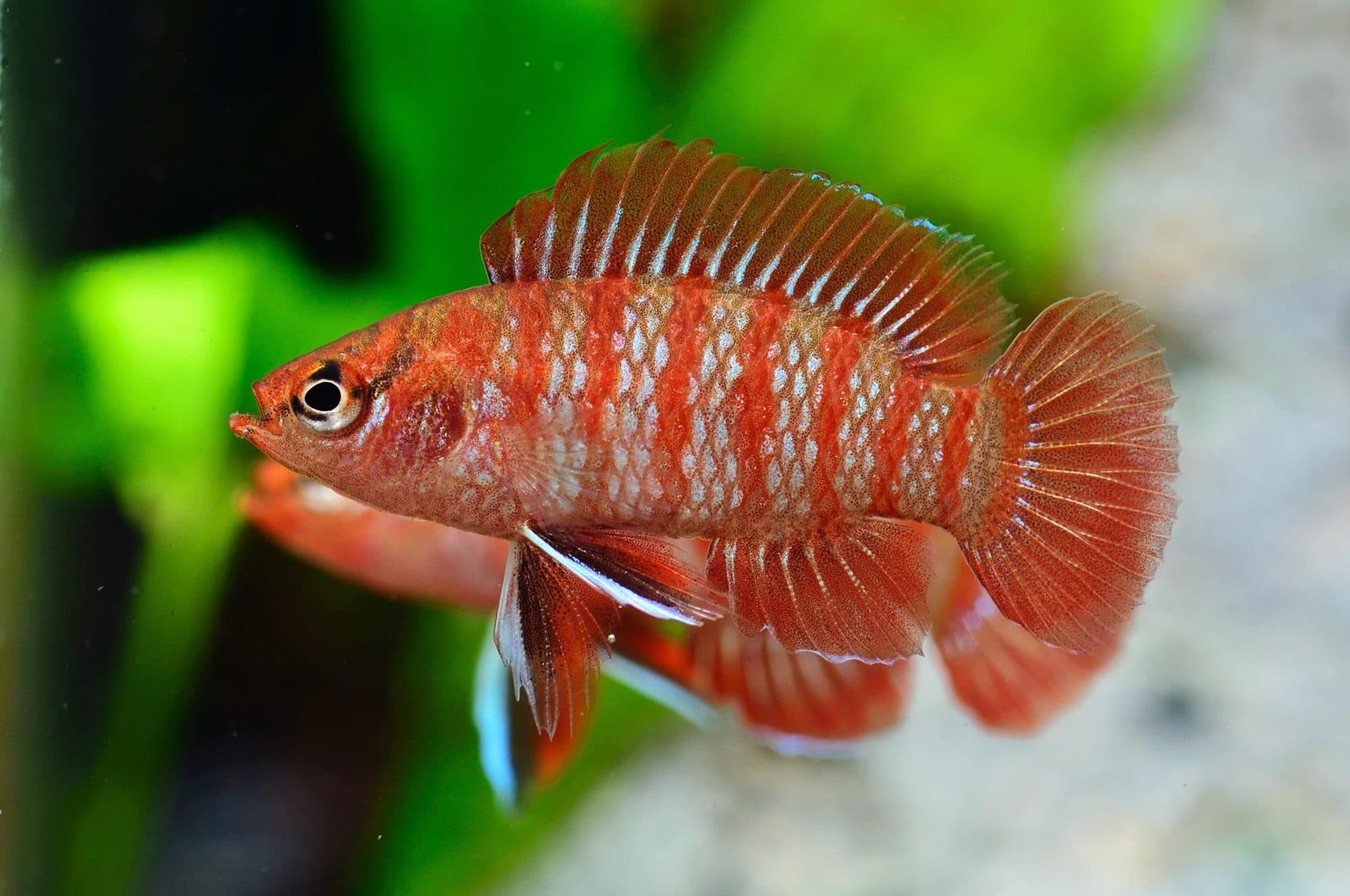
Described in 1822 by Francis Hamilton, the scarlet badis is one of the smallest perciform fish: the male measures about 2 cm. Its name comes from darhi, its Bengali name. The adult male, bright red barred with iridescent blue, has pelvic and dorsal fins edged in blue; the female is drab.
It was long placed in the genus Badis: a 2002 revision by Sven Kullander and Ralf Britz created the genus Dario for it and designated a neotype, as no original specimen existed. The IUCN lists it as data deficient.
- Scientific name
- Dario dario (Hamilton, 1822)
- Classification
- Anabantiformes › Badidae
- IUCN Red List
- Data deficient (DD)
Natural habitat
Tributaries of the Brahmaputra in West Bengal and Assam (India), perhaps Bhutan
Observations (GBIF) and localities Native countries Rivers and lakes
It lives in tributaries of the Brahmaputra, in West Bengal and Assam; the neotype comes from the Janali River, in Kokrajhar district.
It inhabits shallow streams (30 to 70 cm) with crystal-clear water, over sand and gravel, with dense aquatic vegetation (Limnophila, Hygrophila, Vallisneria, Rotala). In the dry season the water there is around 26 °C.
Behaviour
Slow and discreet, it is intimidated and outcompeted by larger tankmates: a species tank or one shared with small midwater fish suits it. Rival males are very aggressive towards each other; keep a pair or one male with several females, except in a spacious tank with well-separated territories.
A micropredator, it often refuses dry food and needs brine shrimp nauplii, daphnia or microworms. It spawns on a surface, in a temporary pair. Shops often offer only males.
Sources:FishBase Seriously Fish GBIF · Base map: Natural Earth