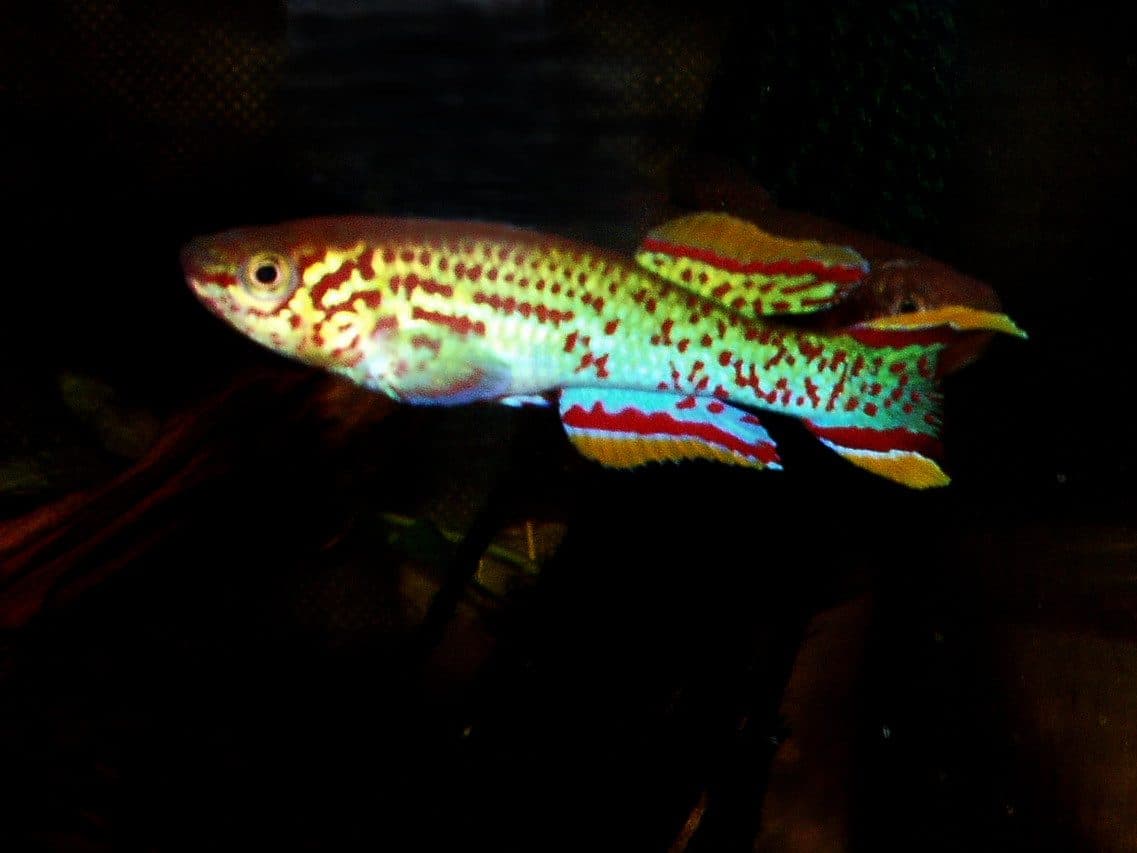
Photo: Alexander Prokoshev, CC BY-SA 4.0, via Wikimedia Commons
Steel-blue killifish
Fundulopanchax gardneri
6 cm
Adult size
50 L
Minimum volume
3
Minimum group
4 years
Lifespan
Water parameters
Understand these values- Genus
- Fundulopanchax
- Diet
- carnivore
- Social life
- harem
In the wild
Overview
Described in 1911 by George Albert Boulenger, the gardneri is named after R. D. Gardner, who collected the type specimens in the upper Cross River basin, near Okwoga. Hardy and colourful, it is one of the most widespread killifish in the hobby.
Its many wild forms are kept separately and named after their locality (Akure, Enugu, Lafia, Nsukka…); three have been described as subspecies, including F. g. lacustris, limited to Lake Ejagham. It belongs to the family Nothobranchiidae.
- Scientific name
- Fundulopanchax gardneri (Boulenger, 1911)
- Classification
- Cyprinodontiformes › Nothobranchiidae
- IUCN Red List
- Least concern (LC)
Natural habitat
Cross River basin (south-eastern Nigeria, western Cameroon) and Benue basin (central Nigeria)
Observations (GBIF) and localities Native countries Rivers and lakes
It lives in creeks, marshes, streams and pools in humid forest, highland savannah and rainforest, in the Cross River and Benue basins.
Some of these habitats dry out from time to time, but not every year; others hold water all year round. The water is soft, slightly acidic to neutral, between 22 and 26 °C.
Behaviour
Hardy, it can live with other fish, but is not a classic community fish: males are aggressive towards each other. With enough hiding places and two or three females per male, a small group does well.
A micropredator, it feeds on small crustaceans, worms and larvae. It has a “semi-annual” breeding strategy: its eggs, laid near the bottom, can hatch underwater in about a month or survive a dry spell.
Sources:FishBase Seriously Fish GBIF · Base map: Natural Earth