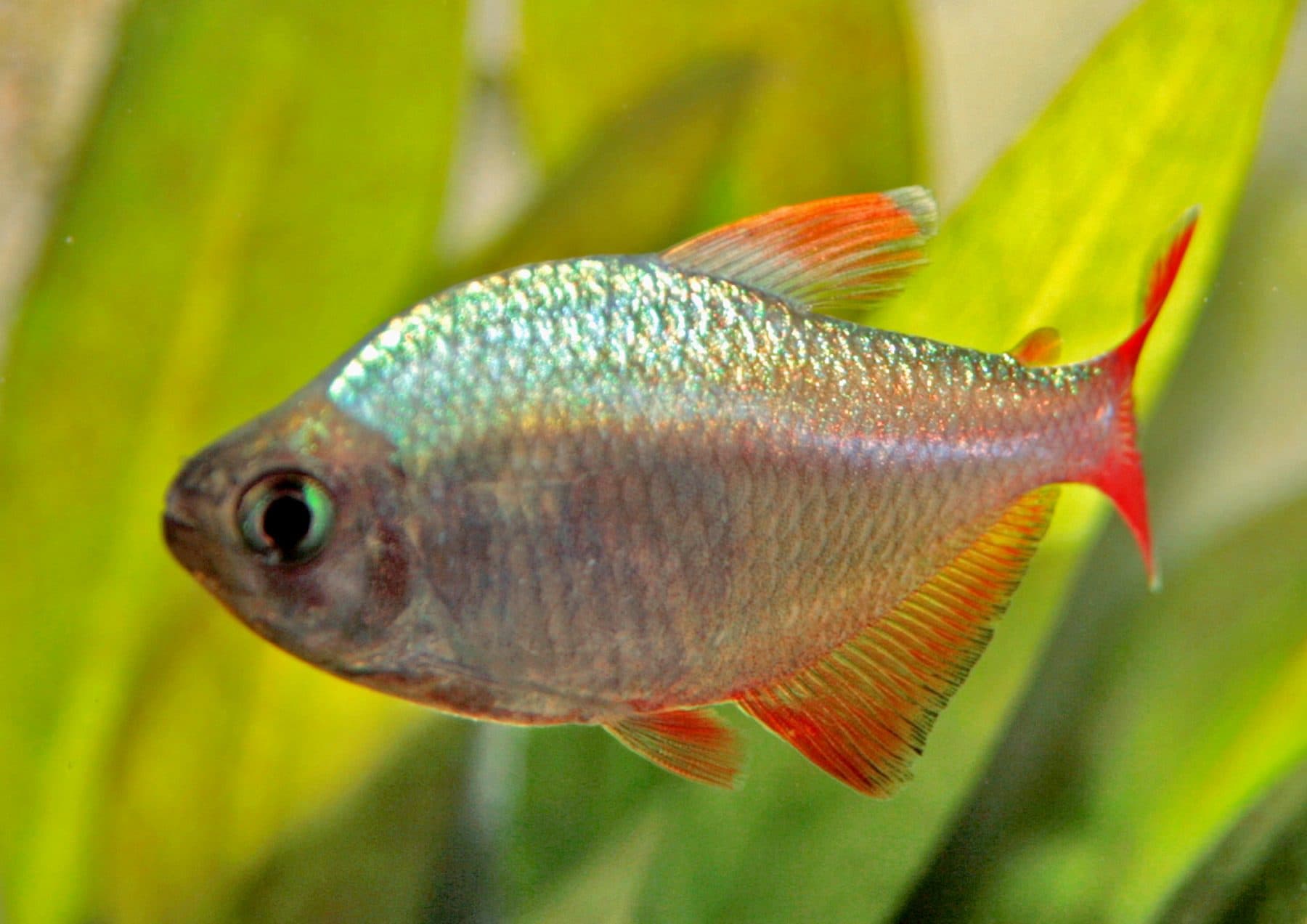
Photo: Marrabbio2, CC BY-SA 3.0, via Wikimedia Commons
Colombian tetra
Hyphessobrycon columbianus
7 cm
Adult size
140 L
Minimum volume
8
Minimum group
5 years
Lifespan
Water parameters
Understand these values- Genus
- Hyphessobrycon
- Diet
- omnivore
- Social life
- shoal
In the wild
Overview
Described in 2002 by Axel Zarske and Jacques Géry, this tetra is named after its country of origin, Colombia. It is close to Hyphessobrycon savagei, endemic to Costa Rica, but differs by its clearly deeper body, an iridescent blue sheen on the upper body in both sexes and blood-red tail and anal fins.
The IUCN lists it as data deficient: its known range is tiny and its biology in the wild remains little studied.
- Scientific name
- Hyphessobrycon columbianus Zarske & Géry, 2002
- Classification
- Characiformes › Acestrorhamphidae
- IUCN Red List
- Data deficient (DD)
Natural habitat
Río Acandí, Chocó department, north-western Colombia near the Panamanian border
Observations (GBIF) and localities Native countries Rivers and lakes
The species is known only from the Río Acandí basin, in the Colombian Darién, on the Caribbean coast near the border with Panama. The type locality is a small stream about 6 km downstream from Acandí.
FishBase reports it from small coastal streams; in the absence of detailed measurements, aquarium parameters rely on breeders' experience: soft to slightly acidic water, between 24 and 29 °C.
Behaviour
Generally peaceful, it lives in a shoal and is more at ease in a mixed group of at least 8 to 10, with characins of similar size, small catfish and non-predatory cichlids. Its size (up to 7 cm) and liveliness make it a robust shoaling fish.
An omnivore, it probably feeds on worms, insects and zooplankton, with a little plant matter. The slimmer, more colourful males develop a longer dorsal fin; it is an egg scatterer with no parental care.
Sources:FishBase Seriously Fish GBIF · Base map: Natural Earth