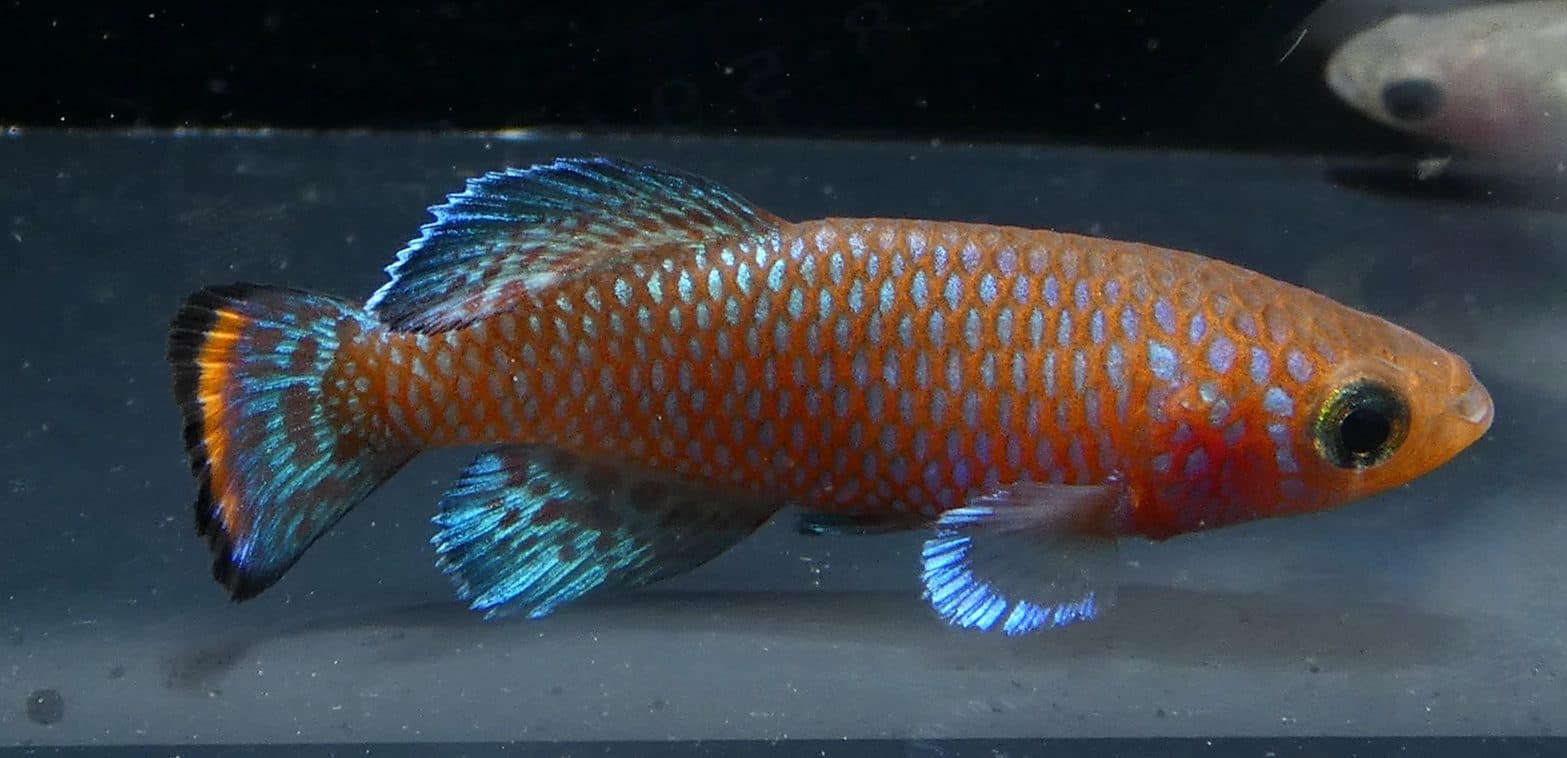
Photo: Andrew Bogott, CC BY-SA 4.0, via Wikimedia Commons
Rachow's nothobranch
Nothobranchius rachovii
5 cm
Adult size
20 L
Minimum volume
2
Minimum group
1 years
Lifespan
Water parameters
Understand these values- Genus
- Nothobranchius
- Diet
- carnivore
- Social life
- pair
In the wild
Overview
Described in 1926 by Ernst Ahl, Rachow's nothobranch is named after the German aquarist Arthur Rachow. It is one of the most colourful annual killifish: the male is covered in a network of blue, red-edged scales, with a flame-coloured tail.
Its life is governed by the seasons: it hatches with the rains, reaches adulthood in three weeks, breeds and dies when its pool dries out, leaving only eggs buried in the mud. The oldest aquarium strain descends from an import made in 1958.
- Scientific name
- Nothobranchius rachovii Ahl, 1926
- Classification
- Cyprinodontiformes › Nothobranchiidae
- IUCN Red List
- Least concern (LC)
Natural habitat
Floodplains of the lower Pungwe and lower Zambezi (Mozambique)
Observations (GBIF) and localities Native countries Rivers and lakes
It lives in depressions, pools and temporary marshes on the floodplains of the lower Pungwe and lower Zambezi, in Mozambique.
The depth of these pools decreases during the dry season until they dry out completely for several months. The vegetation includes grasses, water lilies (Nymphaea), Ottelia and bladderworts; some pools are used to grow rice. It shares them with other Nothobranchius, the African catfish and the lungfish.
Behaviour
Males are territorial and display to each other; keep one male with two or three females in a small species tank. A micropredator, it needs live or frozen prey.
In the aquarium the pair spawns in a tank of fine peat; the peat is then removed and kept damp for several months, like the pool's soil in the dry season, before being re-wetted to hatch the eggs. Its life is short: about a year in the aquarium.
Sources:FishBase Seriously Fish GBIF · Base map: Natural Earth