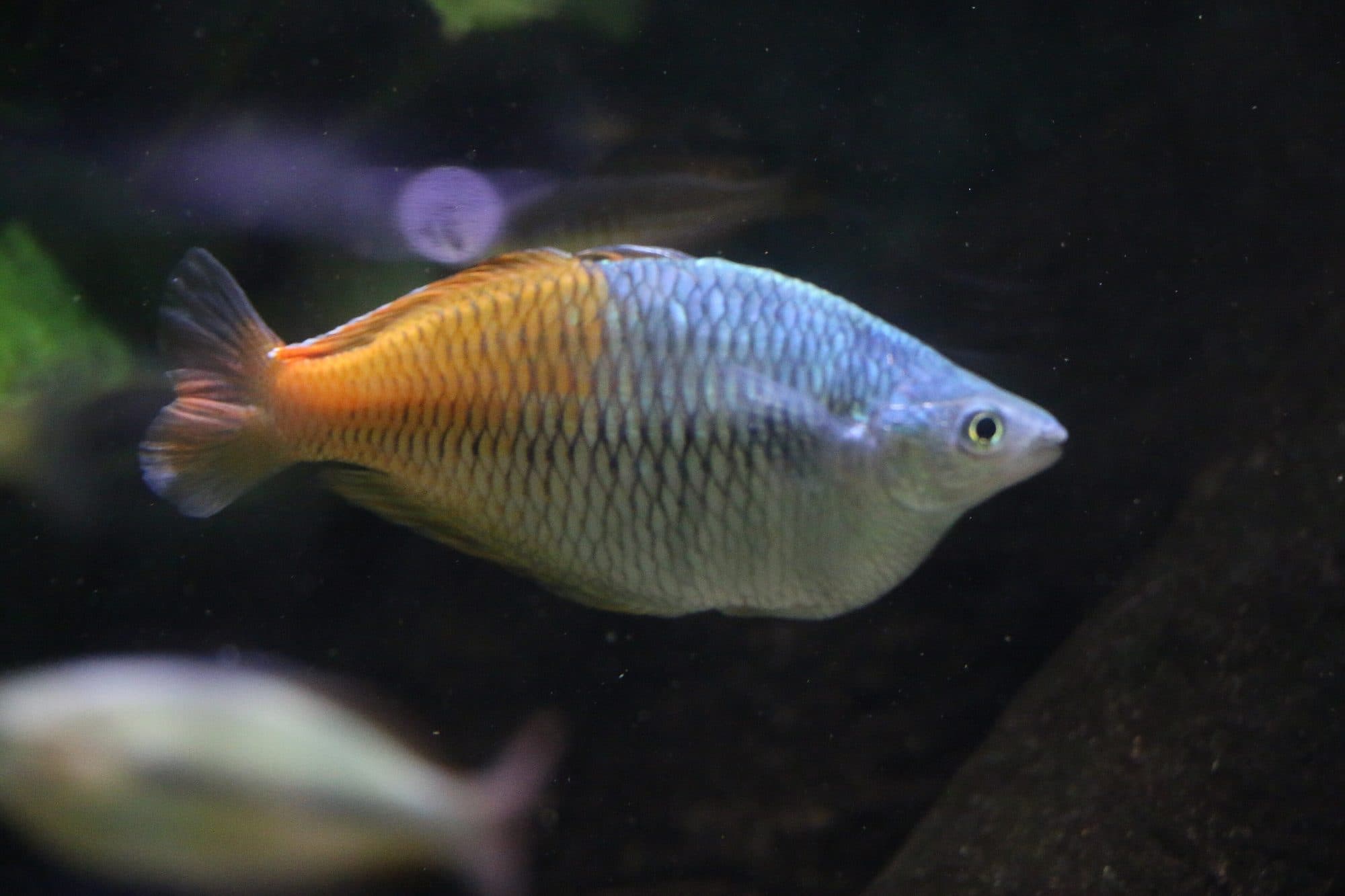
Photo: Cangadoba, CC BY-SA 4.0, via Wikimedia Commons
Boeseman's rainbowfish
Melanotaenia boesemani
9 cm
Adult size
200 L
Minimum volume
5
Minimum group
5 years
Lifespan
Water parameters
Understand these values- Genus
- Melanotaenia
- Diet
- carnivore
- Social life
- shoal
In the wild
Overview
Described in 1980 by Gerald Allen and Norbert Cross, Boeseman's rainbowfish is named after the Dutch ichthyologist Marinus Boeseman. The adult male is spectacular: the front of the body blue-grey, the rear orange-yellow, with a very high back.
The IUCN lists it as endangered: its range is tiny, and mass collection for the hobby in the 1980s greatly reduced its populations. Fish in the trade now come from farms.
- Scientific name
- Melanotaenia boesemani Allen & Cross, 1980
- Classification
- Atheriniformes › Melanotaeniidae
- IUCN Red List
- Endangered (EN)
Natural habitat
Lakes Ajamaru, Hain and Aitinjo, Vogelkop Peninsula (West Papua, Indonesia)
Observations (GBIF) and localities Native countries Rivers and lakes
It is known only from the Ajamaru Lakes, in the heart of the Vogelkop Peninsula (the “bird's head” of New Guinea), and the neighbouring lakes Hain and Aitinjo. These lakes drain into the Kais River and then the Ceram Sea.
The fish gather in clear shallows covered in dense aquatic vegetation. The lake water is hard, alkaline (pH 8 to 9) and warm, although the species also lives in a few tributaries with quite different water.
Behaviour
Very peaceful but lively and rather timid, it does best in a shoal of at least 6 to 8, in a long tank. Its fast movements can disturb slow or smaller fish; it lives with other rainbowfish, barbs, danios and even hard-water African cichlids.
An undemanding omnivore, it colours up better with live or frozen prey. It scatters its eggs among fine-leaved plants or a spawning mop; the tiny fry are delicate to raise.
Sources:FishBase Seriously Fish GBIF · Base map: Natural Earth