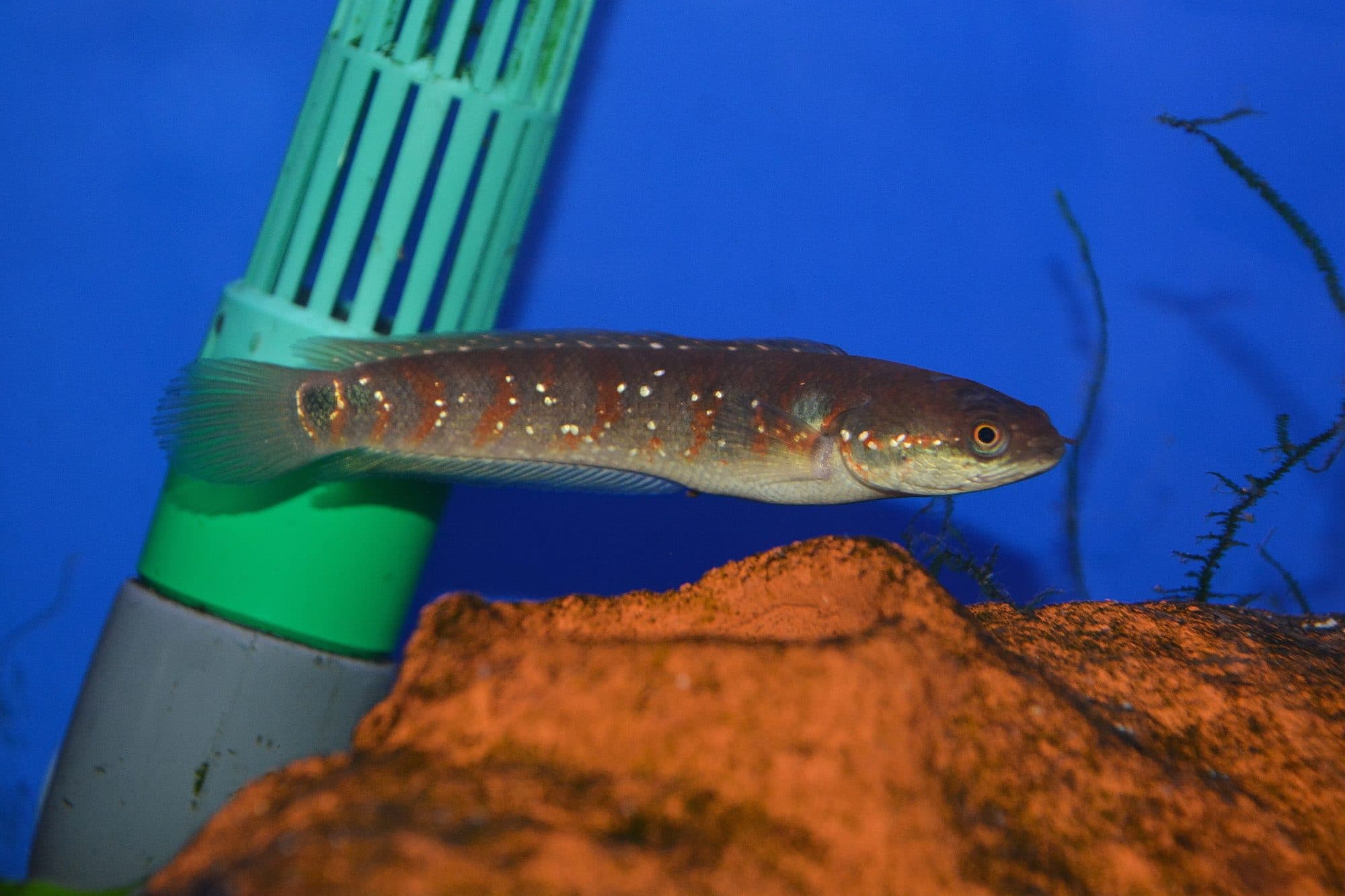
Photo: Jokuyken15, CC BY-SA 4.0, via Wikimedia Commons
Small snakehead
Channa asiatica
35 cm
Adult size
500 L
Minimum volume
1
Minimum group
18 years
Lifespan
Water parameters
Understand these values- Genus
- Channa
- Diet
- carnivore
- Social life
- pair
In the wild
Overview
Described in 1758 by Carl Linnaeus, Channa asiatica is one of the longest-known snakeheads. It is recognised by its black vertical bars on a brown background and the many white dots that speckle its body and fins; it has no pelvic fins.
Its closest relative is the darker Channa nox. It has been introduced to Taiwan and to Ishigaki Island, in the Ryukyu archipelago.
- Scientific name
- Channa asiatica (Linnaeus, 1758)
- Classification
- Anabantiformes › Channidae
- IUCN Red List
- Least concern (LC)
Natural habitat
Central and southern China (up to the Yangtze), Hainan, Hong Kong and the Red River basin (Vietnam)
Observations (GBIF) and localities Native countries Rivers and lakes
It is native to central and southern China, the Yangtze marking the northern limit of its range, as well as Hainan Island, Hong Kong and the Red River basin in northern Vietnam.
A generalist, it lives in ponds, lakes and slow rivers in rainforest regions, hidden among crevices and roots. It tolerates oxygen-poor water and can even crawl short distances over land to reach another body of water.
Behaviour
A predator, it is kept in a species tank. Young fish can live together, but once a pair has formed the other fish are in danger.
It feeds mainly on small fish, crustaceans and insects, and readily accepts non-live food. From about 18 cm, a well-fed pair breeds at least once a year: the parents embrace, thousands of eggs float at the surface and both parents guard the eggs and young. Males have more silvery spots and longer fins.
Sources:FishBase Seriously Fish GBIF · Base map: Natural Earth