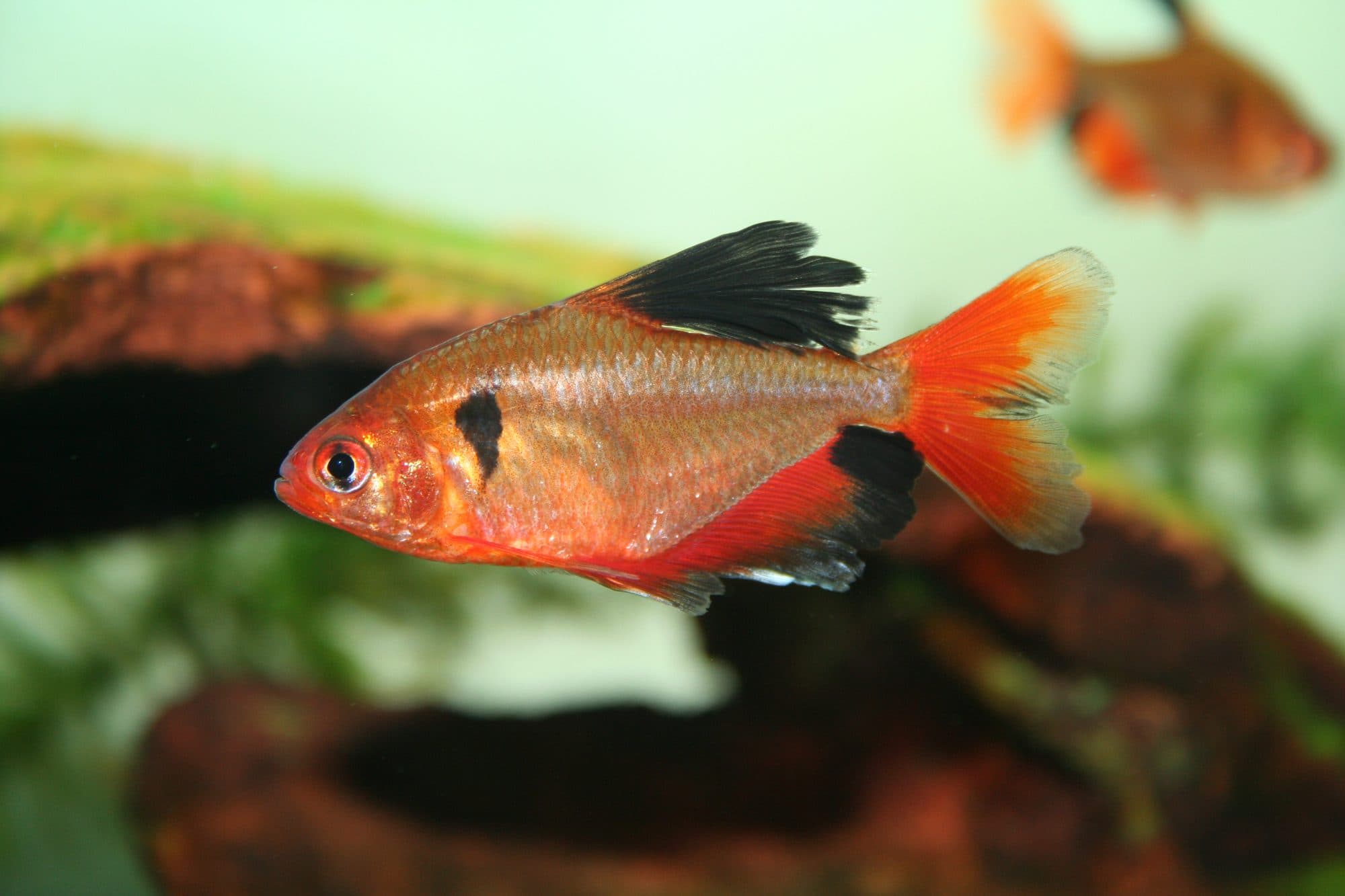
Photo: Faucon, CC BY-SA 2.5, via Wikimedia Commons
Serpae tetra
Hyphessobrycon eques
4 cm
Adult size
100 L
Minimum volume
10
Minimum group
5 years
Lifespan
Water parameters
Understand these values- Genus
- Hyphessobrycon
- Diet
- carnivore
- Social life
- shoal
In the wild
Overview
Described in 1882 by Franz Steindachner, the serpae tetra (or jewel tetra) takes its Latin name eques, “horseman”, from its slender shape. The classification revised in 2024 places it in the genus Megalamphodus, reinstated for this group of red tetras.
Its wild populations vary greatly in colour depending on their origin, and several were once described as separate species. It belongs to a complex of “blood tetras” whose hybrids are common in the aquarium trade.
- Scientific name
- Megalamphodus eques (Steindachner, 1882)Current valid name; in the hobby: Hyphessobrycon eques
- Classification
- Characiformes › Acestrorhamphidae
- IUCN Red List
- Least concern (LC)
Natural habitat
Amazon, Guaporé and Paraguay basins (Brazil, Peru, Bolivia, Paraguay, Argentina, Uruguay)
Observations (GBIF) and localities Native countries Rivers and lakes
Its range is huge: much of the Amazon basin in Brazil, Peru and Bolivia, and the Paraguay basin down to Argentina, connected to Amazonia by the Rio Guaporé. The type locality is Óbidos, on the Amazon.
It mainly frequents calm or still water: slow tributaries, oxbows, ponds and small lakes. Shoals gather around bank vegetation, between the stems of emergent plants, or near submerged roots. It has been introduced to French Guiana through the aquarium trade.
Behaviour
Gregarious, it forms loose hierarchies in which males constantly compete for the females and their place in the group. It has a reputation for nipping other fish's fins, especially if there are too few of them or they are cramped: a group of at least 12 turns this aggression towards their own kind.
Avoid it with slow, long-finned fish (angelfish, bettas). An omnivore, it feeds on worms, crustaceans, insects and plant matter; it is an egg scatterer with no parental care.
Sources:FishBase Seriously Fish GBIF · Base map: Natural Earth