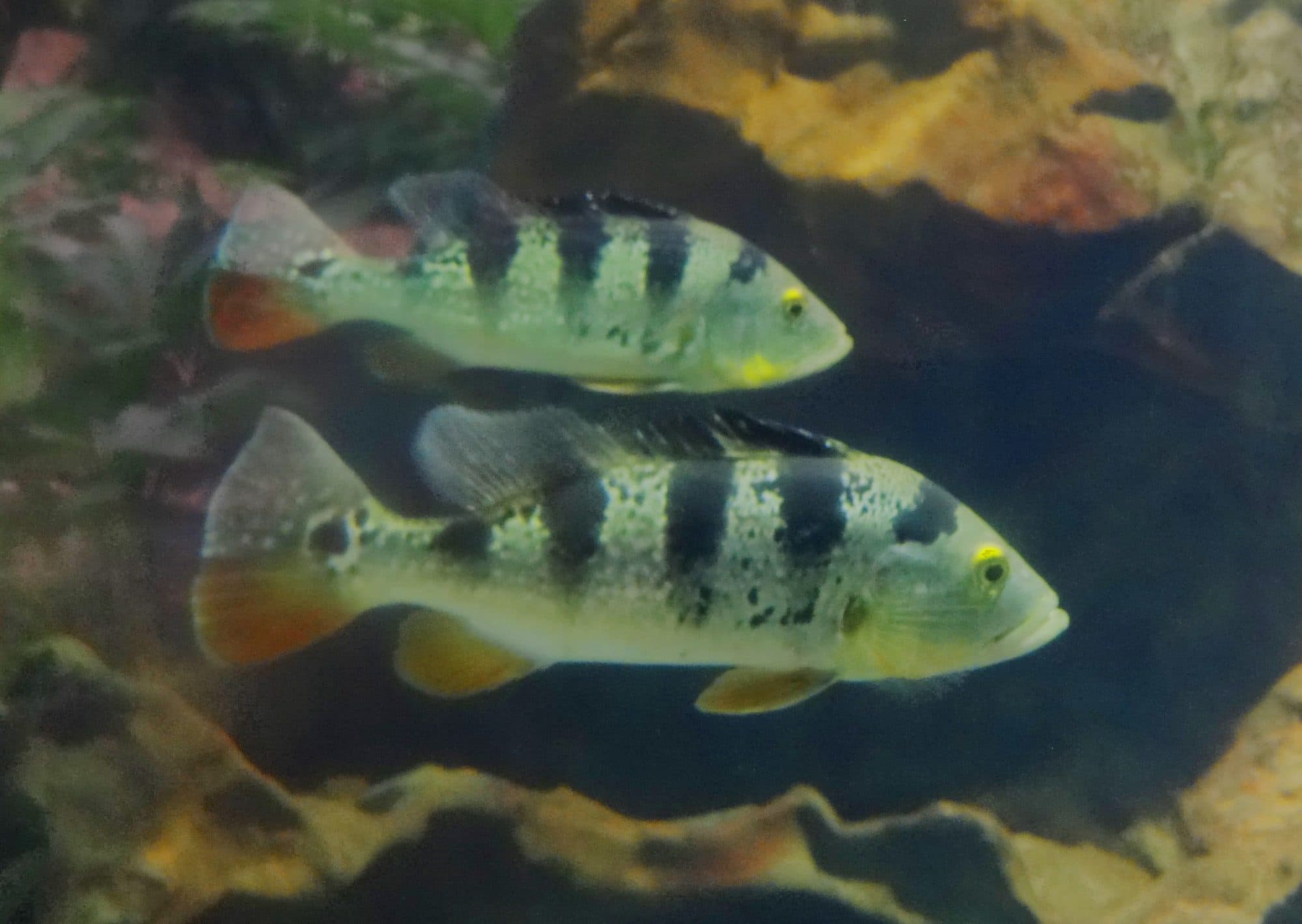
Photo: Petruss, CC BY-SA 4.0, via Wikimedia Commons
Butterfly peacock bass
Cichla ocellaris
60 cm
Adult size
5000 L
Minimum volume
5
Minimum group
12 years
Lifespan
Water parameters
Understand these values- Genus
- Cichla
- Diet
- carnivore
- Social life
- small group
In the wild
Overview
Described in 1801 by Marcus Elieser Bloch and Johann Gottlob Schneider, the mariposa (“butterfly” in Spanish) or peacock bass is a large predatory cichlid that exceeds 70 cm and nearly 7 kg. It has three dark bars and a gold-ringed black eyespot at the base of the tail, hence its name ocellaris.
A 2006 revision of the genus restricted C. ocellaris to the Guiana Shield; fish from the Amazon basin belong to other species. Highly prized by sport anglers, it has been introduced to Florida, Hawaii, Puerto Rico, Panama, Singapore and Malaysia.
- Scientific name
- Cichla ocellaris Bloch & Schneider, 1801
- Classification
- Cichliformes › Cichlidae
- IUCN Red List
- Least concern (LC)
Natural habitat
Guiana Shield: from the Maroni (Suriname, French Guiana) to the Essequibo (Guyana)
Observations (GBIF) and localities Native countries Rivers and lakes
Its natural range runs from the Maroni basin, between Suriname and French Guiana, to the Essequibo basin in Guyana.
Adults live in rapids and in calm water of medium depth over a rocky bottom, where they form shoals. The water is warm (24 to 27 °C), soft and close to neutral.
Behaviour
It is an exclusive fish predator: it eats any tankmate that fits in its mouth. Territorial and fairly aggressive, it can only live with very large fish (arowanas, stingrays, large catfish) in an aquarium of several thousand litres.
It breeds all year round, with a peak at the start of the rainy season: the pair spawns on a flat stone in shallow water, then guards eggs and fry; the eggs hatch in about three days. The adult male develops a nuchal hump.
Sources:FishBase Seriously Fish GBIF · Base map: Natural Earth