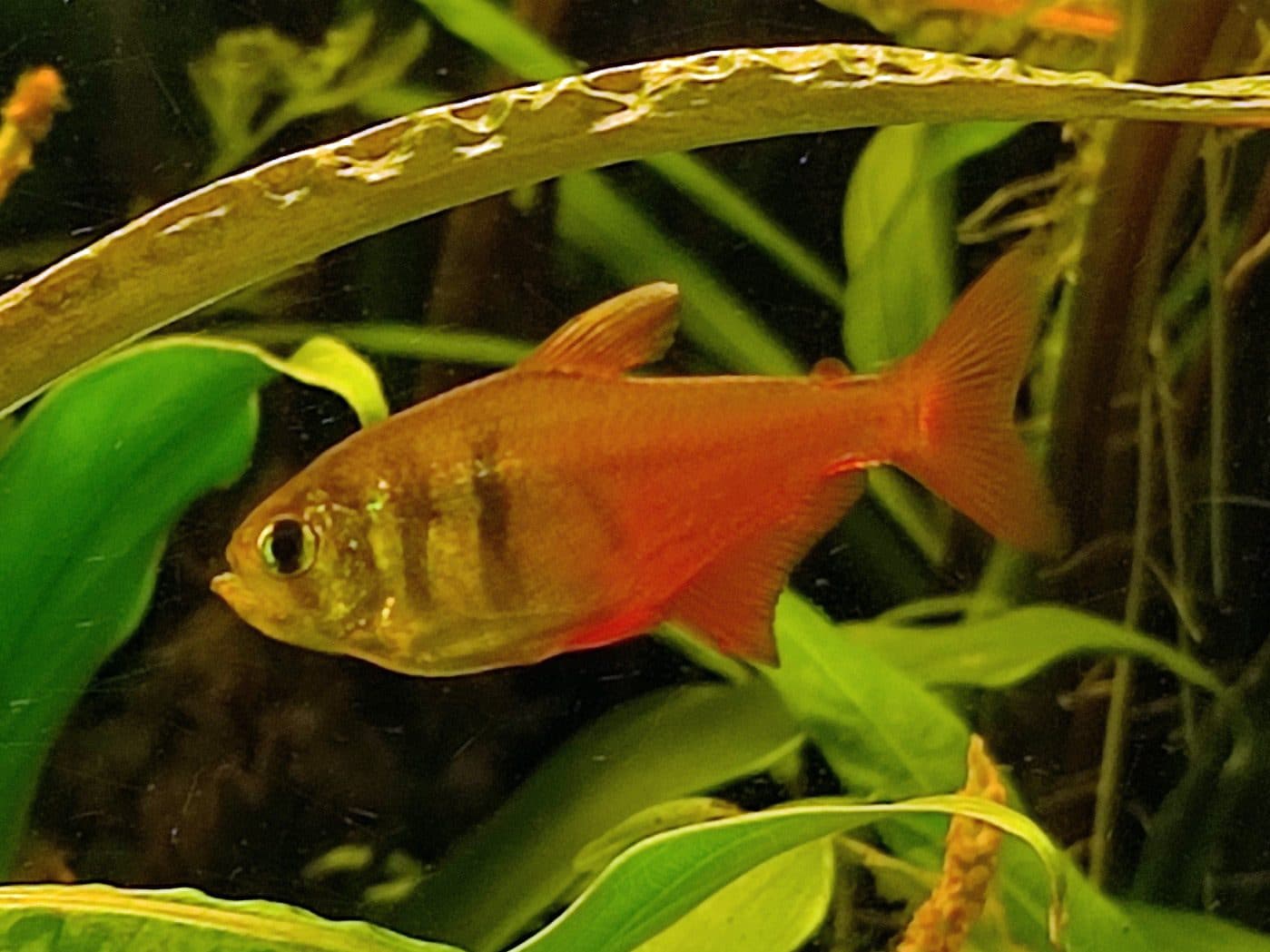
Photo: (c) Igor Balashov, some rights reserved (CC BY), CC BY 4.0, via Wikimedia Commons
Flame tetra
Hyphessobrycon flammeus
3 cm
Adult size
100 L
Minimum volume
10
Minimum group
3 years
Lifespan
Water parameters
Understand these values- Genus
- Hyphessobrycon
- Diet
- carnivore and omnivore
- Social life
- shoal
In the wild
Overview
Described in 1924 by George S. Myers, the flame tetra (or “tetra from Rio”) owes its Latin name flammeus (“flame-coloured”) to its orange-red colouring. It was redescribed in 2014, which clarified the features that separate it from related species: two well-marked vertical humeral spots and a transparent tail fin.
The IUCN lists it as endangered. Its wild populations, in heavily urbanised regions around Rio de Janeiro and São Paulo, have declined sharply; on the other hand, it is bred commercially in several countries, in orange, golden, “diamond” and albino forms.
- Scientific name
- Hyphessobrycon flammeus Myers, 1924
- Classification
- Characiformes › Acestrorhamphidae
- IUCN Red List
- Endangered (EN)
Natural habitat
South-eastern Brazil: Rio de Janeiro and São Paulo states (Guanabara Bay, Rio Paraíba do Sul, upper Rio Tietê)
Observations (GBIF) and localities Native countries Rivers and lakes
It lives in small, shallow streams (under 50 cm) with a slow current, often overgrown with aquatic vegetation, and more rarely along the edges of the main channel of the upper Rio Tietê. The water there is clear to brownish, over sand, between 22 and 28 °C.
Its range includes the coastal rivers flowing into Guanabara Bay, the middle Rio Paraíba do Sul and the Rio Guandu in Rio de Janeiro state, as well as the upper Rio Tietê in São Paulo state.
Behaviour
Peaceful, it forms fairly large shoals within which dominant males establish temporary hierarchies and display to the females: a group of at least 8 to 10 shows these interactions and better colours.
An omnivore, it eats small insects, worms, filamentous algae and organic debris. The female lays 200 to 300 eggs on plants or submerged debris; they hatch in 2 to 3 days. The slimmer, more colourful males have small bony hooks on the anal and pelvic fins.
Sources:FishBase Seriously Fish GBIF · Base map: Natural Earth