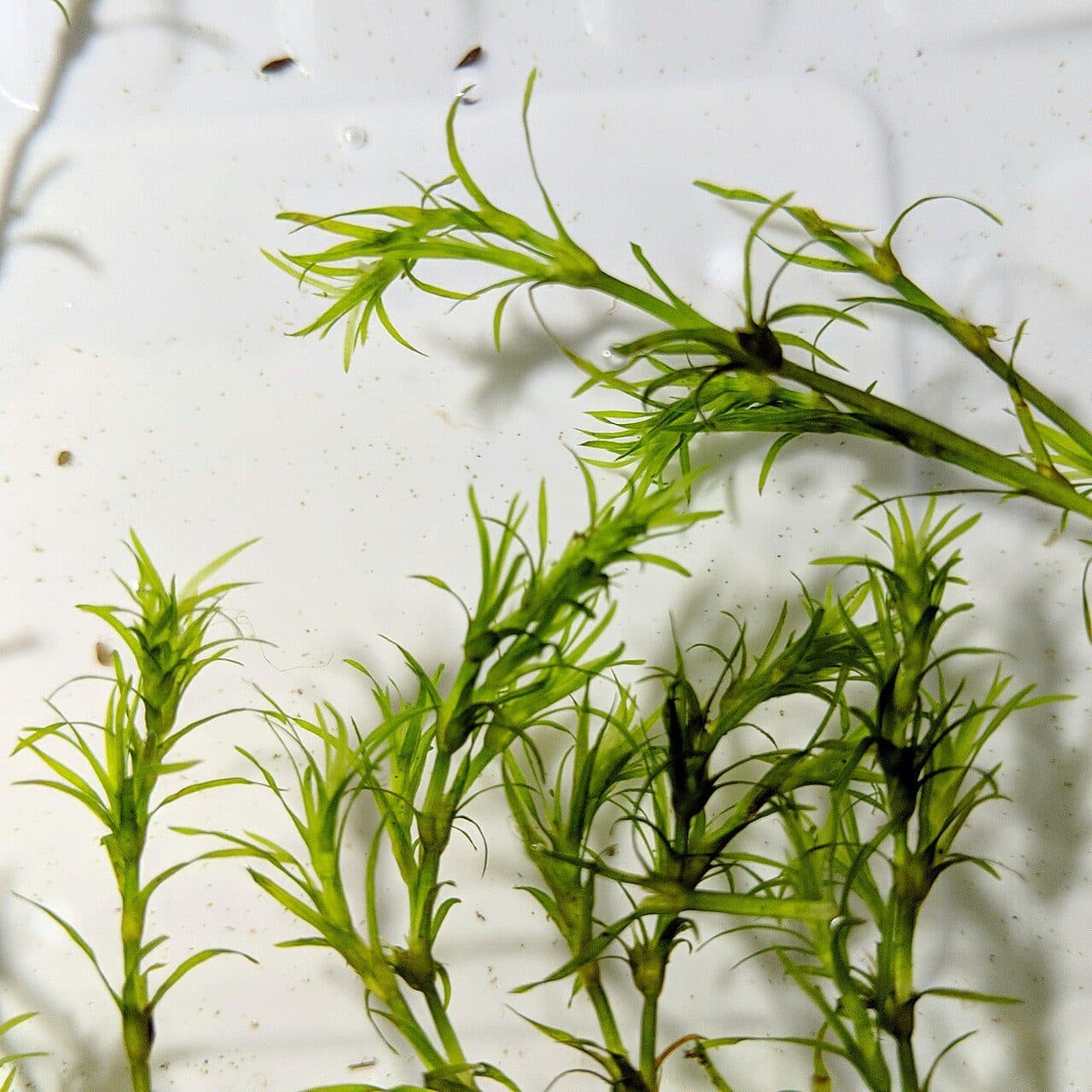
Photo: Timothy McNitt https://www.inaturalist.org/people/frondsinhighplaces, CC BY 4.0, via Wikimedia Commons
Guppy grass
Najas guadalupensis (Spreng.) Magnus
—
Height in the aquarium
low to high
Light
low
CO₂ needs
20–30 °C
Ideal temperature
Water parameters
Understand these values- Position
- background, midground, floating
- Propagation
- fragmentation, cuttings, separating offshoots
- Grows emersed
- no
In the wild
Overview
Known as “Guppy grass”, this American plant quickly forms a network of submerged shoots. Undemanding, it is often used in breeding tanks. Its leaves look smooth at first glance but bear very small teeth. Its brittle stems explain how easily it spreads around the tank.
- Scientific name
- Najas guadalupensis (Spreng.) Magnus
- Classification
- Alismatales › Hydrocharitaceae
- IUCN Red List
- Least concern (LC)
Natural habitat
North America, Central America, Caribbean, tropical South America
Observations (GBIF) and localities Native countries Introduced in Rivers and lakes
- Native countries
- Introduced by people
Outside its native range, in 8 countries:
An aquarium plant must never reach the wild: throwing away cuttings or emptying a tank into a stream can be enough to establish it.
Countries: Kew World Checklist of Vascular Plants (WCVP). Dots: GBIF observations in the native countries.
In the aquarium
Growing in the aquarium
It gets by with little equipment and propagates by fragments. Handle the stems gently; detached pieces can start growing elsewhere and make the planting harder to contain. Remove stray fragments if you want a tidy stand. It is often more useful in a breeding tank than in a highly structured layout.
Sources:Flowgrow GBIF POWO (Kew) Flowgrow — description allemande · Base map: Natural Earth