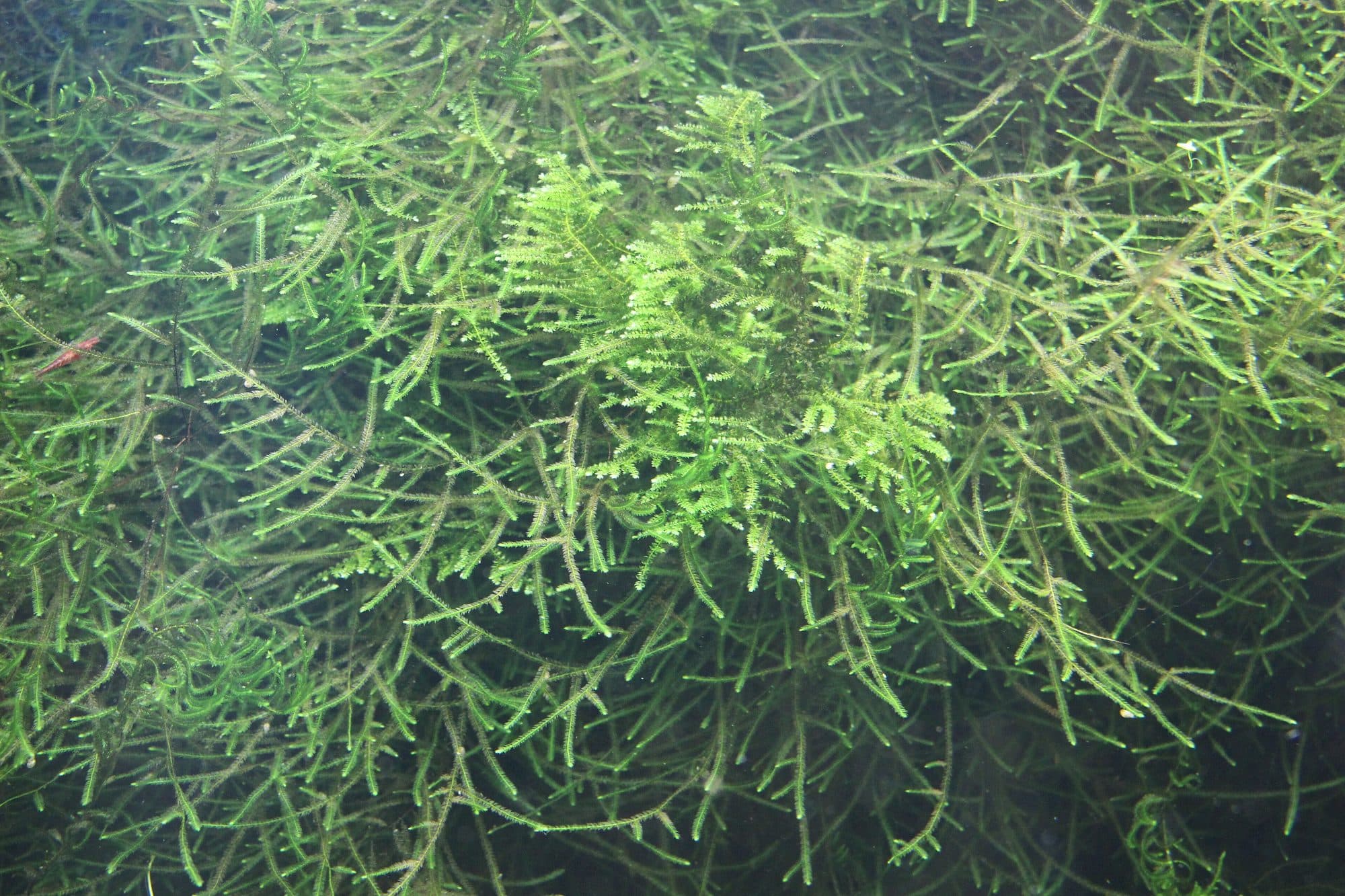
Photo: Xedoo, CC BY-SA 4.0, via Wikimedia Commons
Java moss
Taxiphyllum barbieri (Cardot & Copp.) Z.Iwats.
3–10 cm
Height in the aquarium
low to high
Light
low
CO₂ needs
20–30 °C
Ideal temperature
Water parameters
Understand these values- Position
- on hardscape
- Propagation
- separating offshoots
- Uses
- spawning site, nano tank
- Grows emersed
- yes
In the wild
Overview
The most widely grown moss in aquariums. The name “Java moss” first referred to Vesicularia dubyana, grown in Europe for decades, before Taxiphyllum barbieri, introduced in 1969 as “Bogor moss” and more vigorous, replaced it almost everywhere. The bryologist Zennosuke Iwatsuki identified it as early as 1982; GBIF now places it in the genus Ectropothecium.
Its thin, much-branched stems cling to any support with rhizoids, small brown filaments that act as roots: wood, stone, and even plastic or glass covered in algae.
- Scientific name
- Ectropothecium barbieri Current valid name; in the hobby: Taxiphyllum barbieri
- Classification
- Hypnales › Hypnaceae
- IUCN Red List
- Not evaluated (NE)
Natural habitat
Southeast Asia; botanists have recorded it in the wild only in Vietnam
Native countries Rivers and lakes
- Countries where it is observed
Mosses are not in the Kew checklist of vascular plants: countries where GBIF has at least two observations on the native continents given by Flowgrow, unless a source is cited.
In the aquarium
Growing in the aquarium
Very undemanding in terms of light and water quality. Under strong light it grows denser and paler; in dim light, darker and looser. It tolerates 30 °C, but grows faster and looks better around 24 °C. An iron-rich fertiliser and added CO2 help without being necessary.
Tie it to a root or a stone with nylon thread until it takes hold, then trim it with scissors to keep the shape you want. Dense and bushy, it gives shelter to fry and shrimp, and a place to spawn.