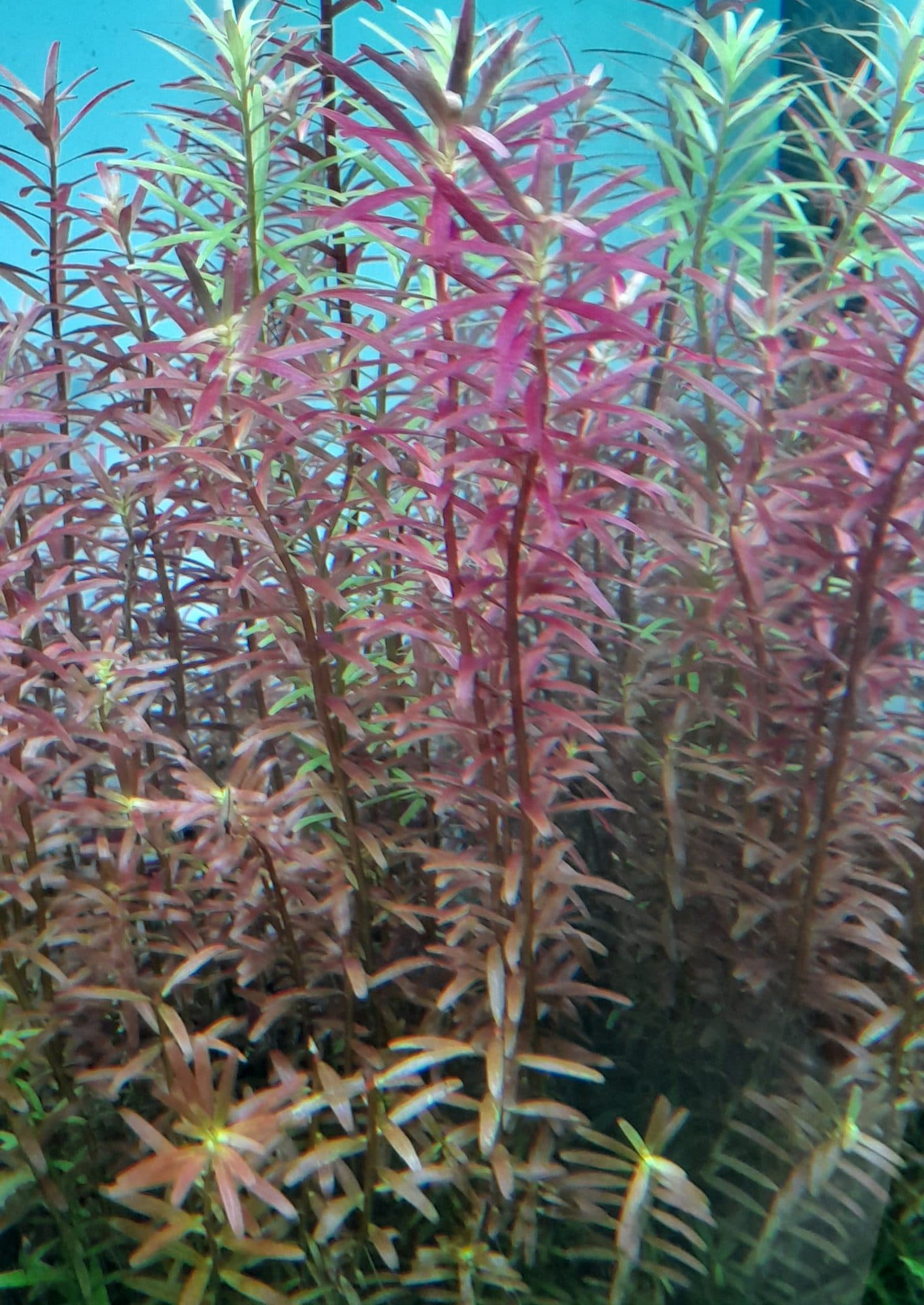
Photo: Yercaud-elango, CC BY 4.0, via Wikimedia Commons
Dwarf rotala
Rotala rotundifolia (Buch.-Ham. ex Roxb.) Koehne
15–30 cm
Height in the aquarium
medium to high
Light
low
CO₂ needs
22–28 °C
Ideal temperature
Water parameters
Understand these values- Position
- background, midground
- Propagation
- cuttings
- Grows emersed
- yes
In the wild
Overview
A classic aquarium plant, introduced around 1960 under the wrong name Rotala indica, a confusion that still lingers. Its name means “round-leaved”, but only the creeping marsh form has round leaves: underwater it bears elongated, oval to linear leaves. Out of water it flowers in pink spikes at the top of the stems.
Several forms are in the trade (“Green”, “H'Ra”, “Colorata”...), and their colour depends a great deal on growing conditions, which makes them hard to identify.
- Scientific name
- Rotala rotundifolia (Buch.-Ham. ex Roxb.) Koehne
- Classification
- Myrtales › Lythraceae
- IUCN Red List
- Least concern (LC)
Natural habitat
South, Southeast and East Asia, up to 2,700 m: marshes, banks and rice fields; naturalised in the southern United States
Observations (GBIF) and localities Native countries Introduced in Rivers and lakes
- Native countries
- Introduced by people
Outside its native range, in 3 countries:
An aquarium plant must never reach the wild: throwing away cuttings or emptying a tank into a stream can be enough to establish it.
Countries: Kew World Checklist of Vascular Plants (WCVP). Dots: GBIF observations in the native countries.
In the aquarium
Growing in the aquarium
Undemanding for a rotala, it grows under medium light but only takes on its pink to reddish hues under strong light. The best colours come with low nitrates and enough phosphates, iron and trace elements.
It is very easy to propagate: simply replant the tops or the side shoots. Trimmed, it branches and becomes bushy; it then needs frequent trimming so that light reaches the bottom of the stems. It goes in the midground or background.
Sources:Flowgrow Tropica GBIF POWO (Kew) · Base map: Natural Earth