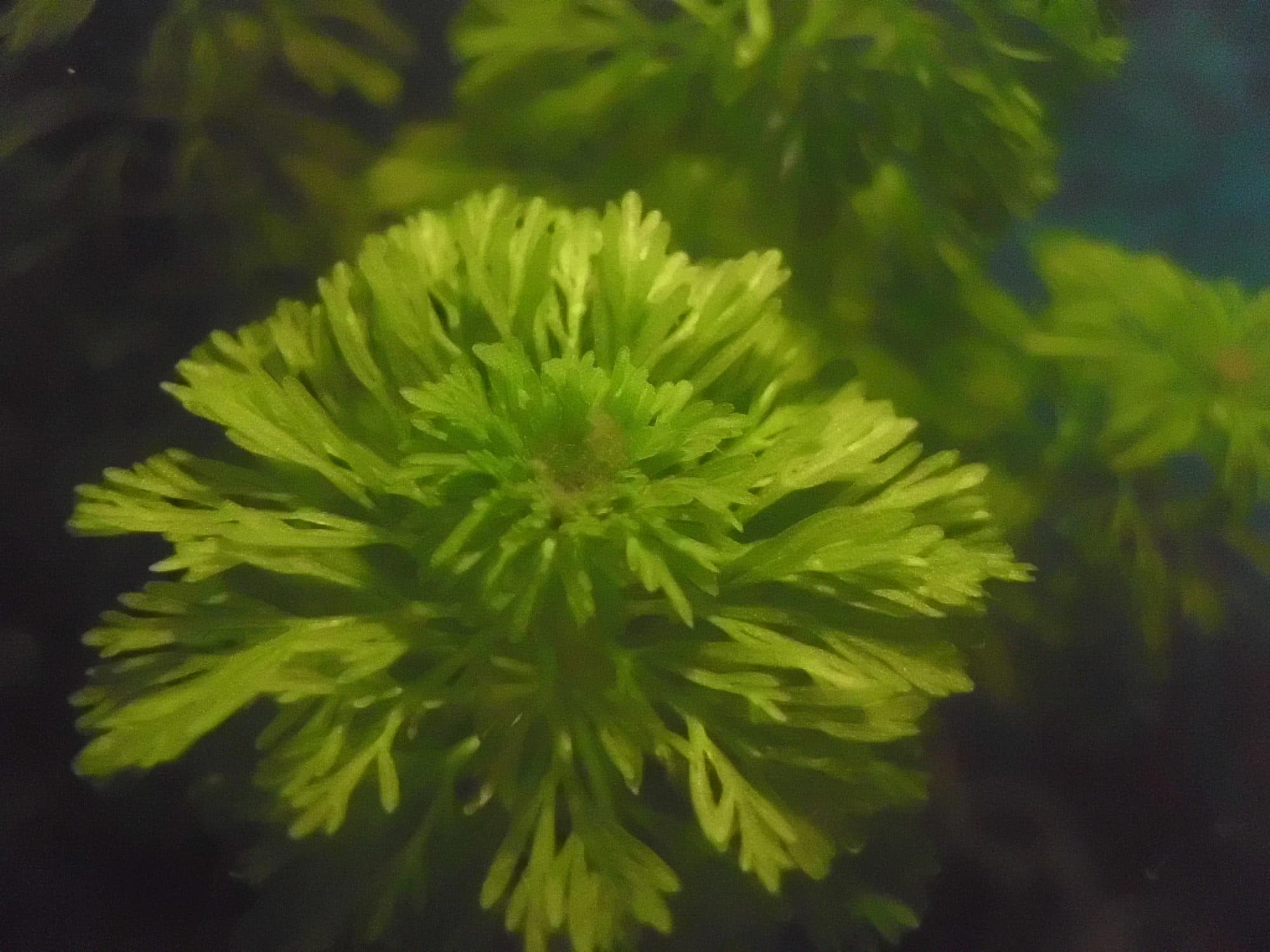
Photo: Andreus Felipen, CC BY-SA 3.0, via Wikimedia Commons
Asian marshweed (ambulia)
Limnophila sessiliflora (Vahl) Blume
15–30 cm
Height in the aquarium
medium to high
Light
low
CO₂ needs
20–26 °C
Ideal temperature
Water parameters
Understand these values- Position
- background
- Propagation
- cuttings
- Grows emersed
- yes
In the wild
Overview
The most widely grown Limnophila, long sold as “Ambulia”. Its stems bear whorls of finely cut leaves that recall cabombas, but it needs much less light.
Introduced outside its native range, it has become an invasive plant that threatens natural habitats, for example in the United States: never release cuttings into the wild.
- Scientific name
- Limnophila sessiliflora (Vahl) Blume
- Classification
- Lamiales › Plantaginaceae
- IUCN Red List
- Least concern (LC)
Natural habitat
South, Southeast and East Asia: edges of still water, banks of rivers and streams
Observations (GBIF) and localities Native countries Introduced in Rivers and lakes
- Native countries
- Introduced by people
Outside its native range, in 5 countries:
An aquarium plant must never reach the wild: throwing away cuttings or emptying a tank into a stream can be enough to establish it.
Countries: Kew World Checklist of Vascular Plants (WCVP). Dots: GBIF observations in the native countries.
In the aquarium
Growing in the aquarium
Hardy and adaptable. With enough light and added CO2 it stays compact and its tips turn slightly red; in dim light its stems stretch and become bare. A complete fertiliser with iron is needed.
Its very fast growth means frequent trimming: cut the top of the stems and replant the tips, which also propagates it. Once it reaches the surface it branches a lot and can grow out of the water; submerged it almost never flowers, but grown emersed it bears purple flowers. Plant in a group, in the background.
Sources:Flowgrow Tropica GBIF POWO (Kew) · Base map: Natural Earth