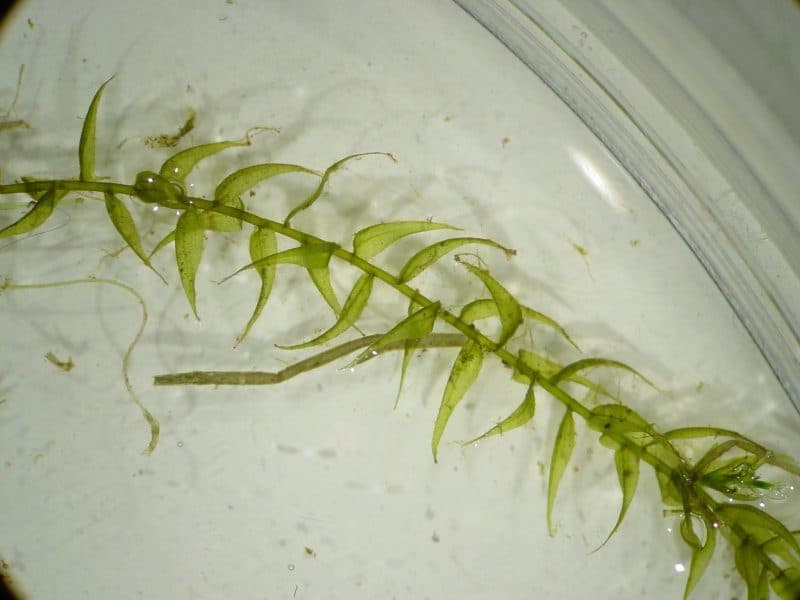
Photo: Kristian Peters -- Fabelfroh 10:42, 2 March 2006 (UTC), CC BY-SA 3.0, via Wikimedia Commons
Hook moss
Drepanocladus aduncus (Hedw.) Warnst.
—
Height in the aquarium
low to high
Light
low
CO₂ needs
4–30 °C
Tolerated temperature
Water parameters
Understand these values- Position
- midground, foreground
- Propagation
- separating offshoots
- Uses
- spawning site, nano tank
- Grows emersed
- yes
In the wild
Overview
This aquatic moss forms dark green tufts whose shoots and leaves can curve like a sickle. In low light the submerged stems stand up and branch little; near the surface they become bushier. It recalls the mosses sold as “Stringy Moss”.
- Scientific name
- Drepanocladus aduncus (Hedw.) Warnst.
- Classification
- Hypnales › Amblystegiaceae
- IUCN Red List
- Not evaluated (NE)
Natural habitat
North Africa, Central Africa, East Africa, Europe, North Asia, West Asia, Central Asia, East Asia, New Zealand, North America, Central America
Observations (GBIF) and localities Native countries Rivers and lakes
- Countries where it is observed
Mosses are not in the Kew checklist of vascular plants: countries where GBIF has at least two observations on the native continents given by Flowgrow, unless a source is cited.
In the aquarium
Growing in the aquarium
It suits cool tanks as well as warmer, simply equipped aquariums. Tie it to wood or stone, then keep its growth in check if conditions let it run wild. Propagate by division. Check its identity: the source notes that some mosses sold as “Aduncus Moss” belong to other species.