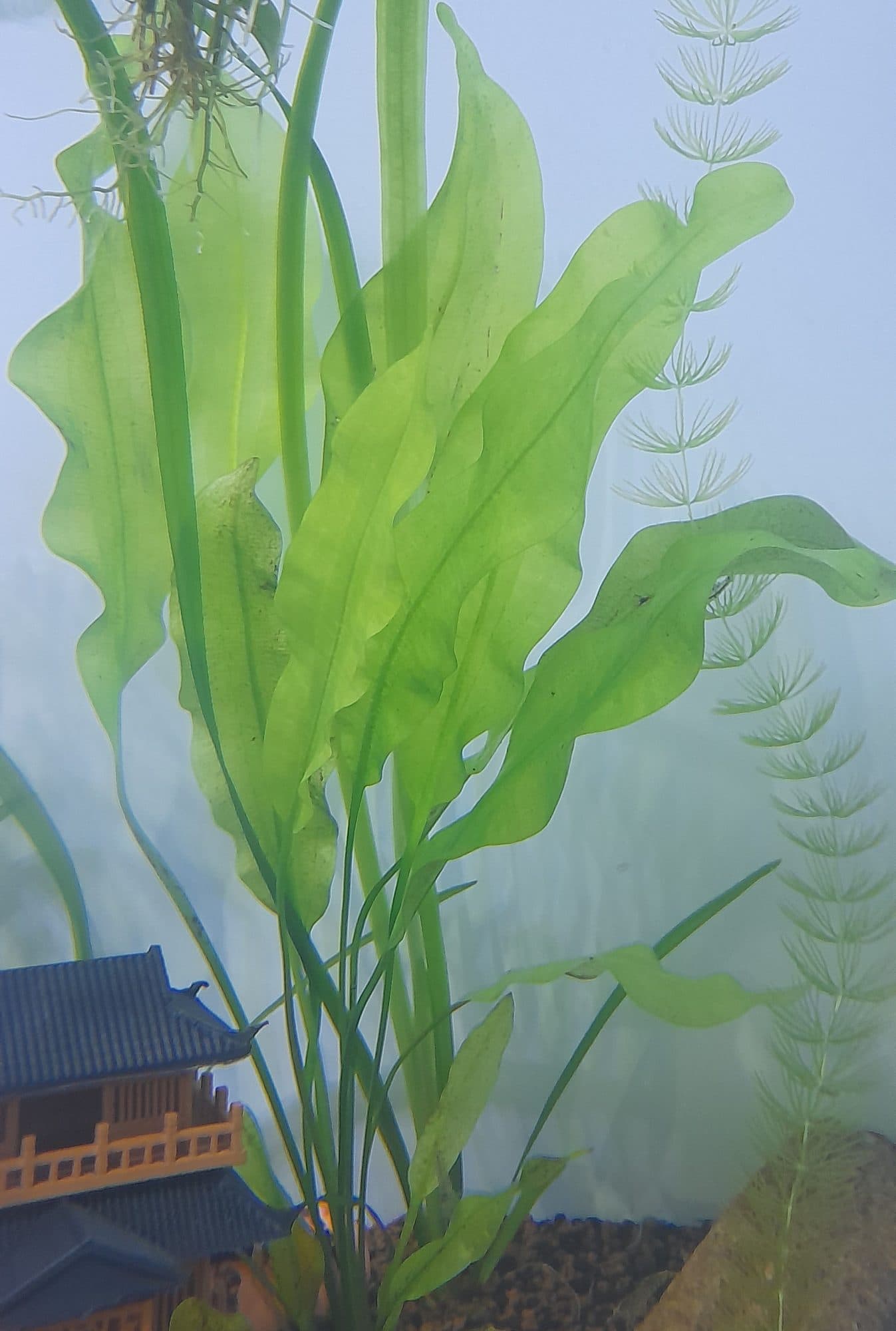
Photo: Yercaud-elango, CC BY 4.0, via Wikimedia Commons
Amazon sword
Echinodorus grisebachii 'Bleherae' Small
20–30 cm
Height in the aquarium
medium to high
Light
low
CO₂ needs
22–26 °C
Ideal temperature
Water parameters
Understand these values- Position
- background
- Propagation
- plantlets on the flower stalk, rhizome division
- Grows emersed
- yes
In the wild
Overview
Known to aquarists as Echinodorus bleheri, it is probably the most widespread sword plant in aquariums. Its exact origin remains unclear, perhaps the Amazon; it belongs to the Echinodorus grisebachii group, like the “Amazonicus” and “Parviflorus” forms. It was long sold as E. paniculatus, a name that actually refers to quite a different plant. GBIF now places the species in the genus Aquarius.
In the wild these plants spend most of the year underwater and only form aerial leaves and flower stalks when the water recedes. The most common form is triploid: its small flowers, 1.5 cm at most, are sterile.
- Scientific name
- Aquarius grisebachii Current valid name; in the hobby: Echinodorus grisebachii 'Bleherae'
- Classification
- Alismatales › Alismataceae
- IUCN Red List
- Not evaluated (NE)
Natural habitat
Tropical South America, probably the Amazon; the E. grisebachii group is widespread in tropical America
Observations (GBIF) and localities Native countries Rivers and lakes
- Native countries
- Introduced by people
No introduction reported outside its native range.
Countries: Kew World Checklist of Vascular Plants (WCVP). Dots: GBIF observations in the native countries.
In the aquarium
Growing in the aquarium
Easy and vigorous, it adapts to very varied water and grows even in a dimly lit aquarium, because its leaves climb towards the light. Its size is often underestimated: the height given is that of the first months, but a healthy adult plant exceeds 60 cm in both height and width. It is therefore for large aquariums, where it makes a superb specimen plant; for a medium tank, the “Parviflorus” form stays around 30 cm.
A nutrient-rich substrate helps it grow, and the large leaves that rob the plants below of light must be cut. It is propagated with the plantlets that form on the flower stalk, or by dividing the rhizome.
Sources:Flowgrow Tropica GBIF POWO (Kew) Quality Marine (pH et KH) · Base map: Natural Earth