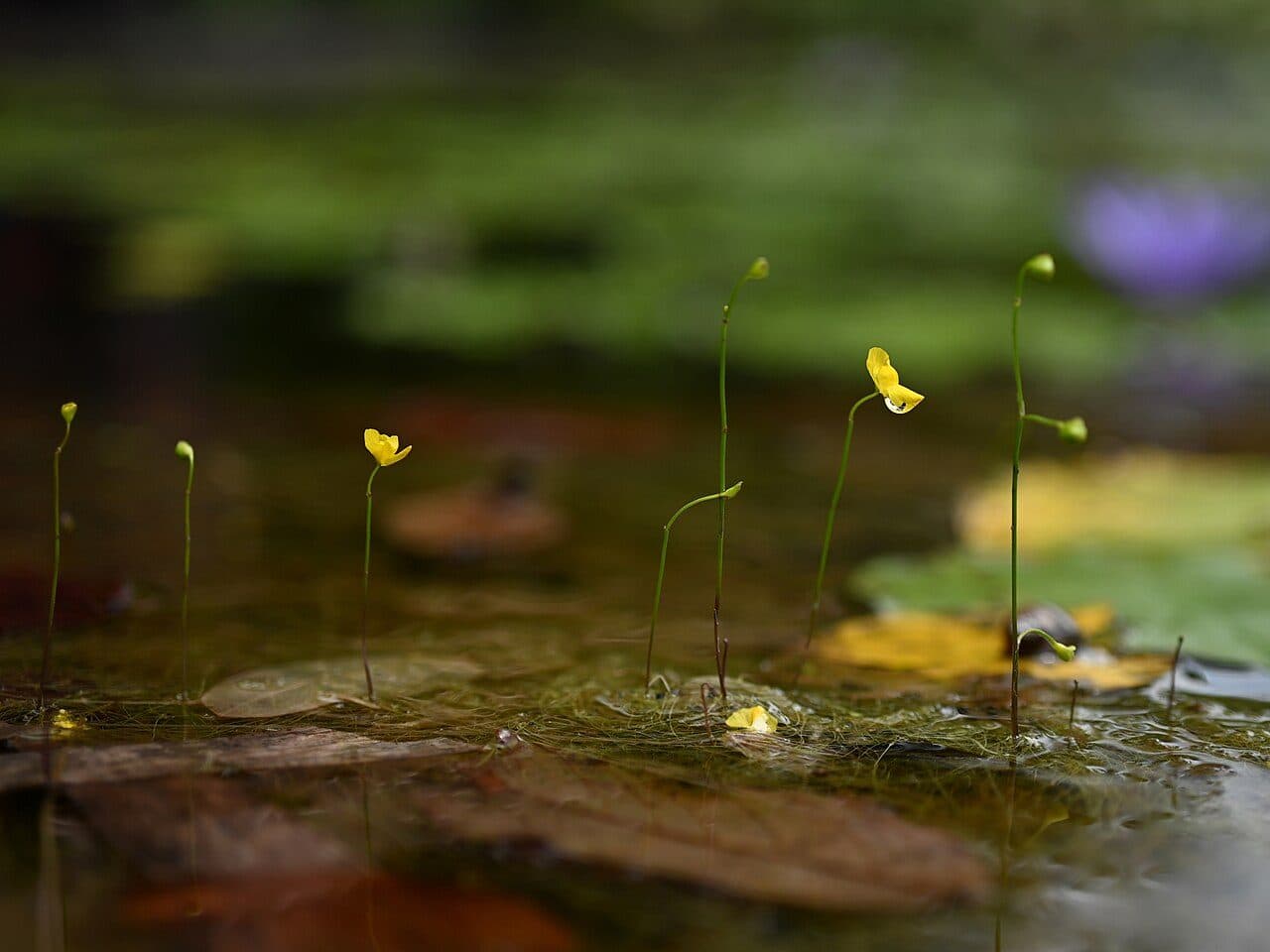
Photo: Krzysztof Ziarnek, Kenraiz, CC BY-SA 4.0, via Wikimedia Commons
Humped bladderwort
Utricularia gibba L.
—
Height in the aquarium
low to high
Light
low
CO₂ needs
18–30 °C
Ideal temperature
Water parameters
Understand these values- Position
- floating
- Propagation
- fragmentation, cuttings, separating offshoots
- Grows emersed
- yes
In the wild
Overview
Its extremely thin stems tangle into cushions in the water or between other plants. Small traps catch microscopic organisms, with no danger to fry or young shrimp observed in the source. It can, however, invade mosses and plant carpets, often after being introduced by accident.
- Scientific name
- Utricularia gibba L.
- Classification
- Lamiales › Lentibulariaceae
- IUCN Red List
- Least concern (LC)
Natural habitat
Africa, Madagascar region, Europe, Asia, Australia, Oceania, the Americas
Observations (GBIF) and localities Native countries Introduced in Rivers and lakes
- Native countries
- Introduced by people
Outside its native range, in 3 countries:
An aquarium plant must never reach the wild: throwing away cuttings or emptying a tank into a stream can be enough to establish it.
Countries: Kew World Checklist of Vascular Plants (WCVP). Dots: GBIF observations in the native countries.
In the aquarium
Growing in the aquarium
It tolerates many conditions and regrows from tiny fragments. To contain it, patiently remove the shoots with tweezers and check for pieces left in the stands. Well-tuned fertilisation is not enough to stop it spreading. It mostly interests carnivorous plant enthusiasts, rather than a layout where every stand must stay separate.
Sources:Flowgrow GBIF POWO (Kew) · Base map: Natural Earth