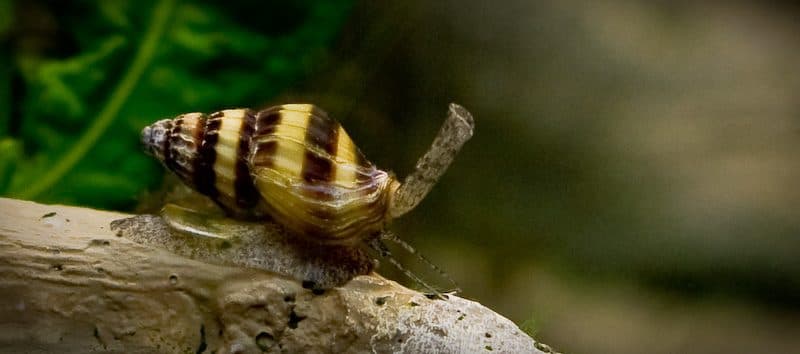
Photo: RSX, CC BY-SA 3.0, via Wikimedia Commons
Views: 1 — animal ; 2 — coquille ; 3 — coquille.
Assassin snail
Clea helena
2 cm
Adult size
10 L
Minimum volume
1
Minimum group
—
Lifespan
Size: shell height.
Water parameters
Understand these valuesHardness (GH): not given by the sources
Carbonate hardness (KH): not given by the sources
- Genus
- Clea
- Diet
- carnivore
- Social life
- solitary
- Activity
- diurnal
- Adult habitat
- fresh water
- Breeding
- in fresh water
In the wild
Overview
The assassin snail has a yellowish shell banded with reddish brown. Unlike snails that mainly graze algae, it catches other gastropods and also eats dead animal matter. The trade uses several names, to be checked against the taxonomy given on this page.
- Scientific name
- Anentome helena Busch, 1847Current valid name; in the hobby: Clea helena
- Classification
- Neogastropoda › Nassariidae
- IUCN Red List
- Not evaluated (NE)
Natural habitat
Tropical Southeast Asia: Thailand, Cambodia, Vietnam, Malaysia and Sumatra; introduced in Singapore
Observations (GBIF) and localities Native countries Rivers and lakes
It lives in the oxygenated water of lakes, rivers and streams, between 22 and 28 °C, and avoids both still and brackish water. It belongs to the same family as the marine whelks, but lives only in fresh water.
Behaviour
Solitary and active by day, it is a predatory snail: it catches other snails and also feeds on carrion. It readily buries itself in the substrate.
In the aquarium
Care and setup
Provide a substrate it can burrow into. It cannot be kept if every other snail in the tank must be protected: its predatory diet has to be taken into account.
Feeding
Offer suitable animal food; its diet must not be confused with that of an algae-grazing nerite.
Breeding
The sexes are separate. The female lays its eggs one by one in capsules; the young stay hidden in the substrate.
Sources:Fishipedia GBIF · Base map: Natural Earth