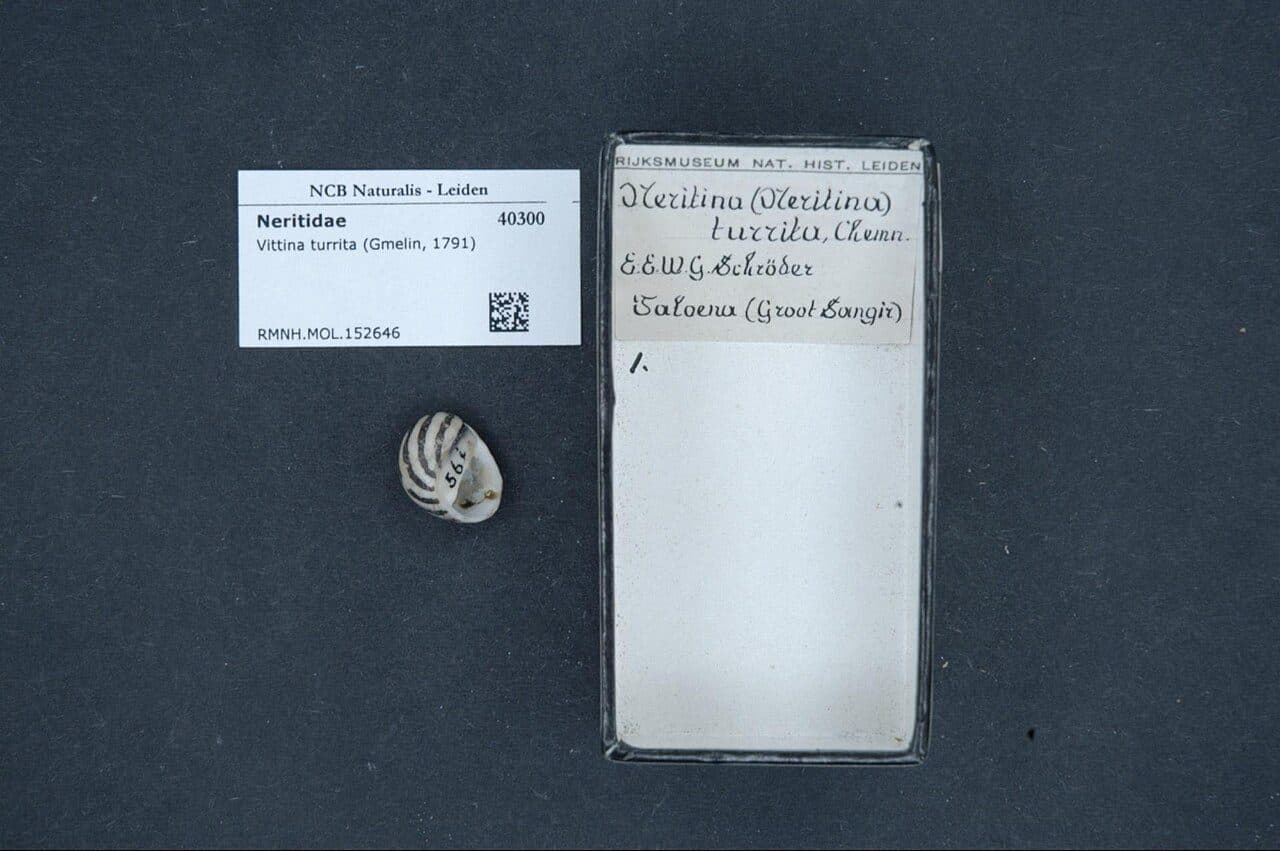
Photo: Gmelin, 1791, CC0, via Wikimedia Commons
Views: 1 — coquille ; 2 — coquille ; 3 — coquille.
Turrita nerite
Vittina turrita
3 cm
Adult size
50 L
Minimum volume
1
Minimum group
—
Lifespan
Size: shell height.
Water parameters
Understand these valuesHardness (GH): not given by the sources
Carbonate hardness (KH): not given by the sources
- Genus
- Vittina
- Diet
- grazer
- Social life
- alone or in a group
- Activity
- diurnal
- Adult habitat
- fresh water
- Breeding
- larvae in the sea
In the wild
Overview
This nerite usually bears yellow and black diagonal stripes. It grazes submerged surfaces near the surface and is hard to tell apart with certainty from some related species. This page keeps the source's name and its taxonomic match.
- Scientific name
- Vittina turrita (Gmelin, 1791)
- Classification
- Cycloneritida › Neritidae
- IUCN Red List
- Not evaluated (NE)
Natural habitat
Pacific islands (Fiji, Vanuatu, Solomon Islands, Micronesia, New Caledonia, French Polynesia) and the Philippines (Palawan); also reported in South Asia
Observations (GBIF) and localities Native countries Rivers and lakes
It lives very close to the surface, on rocky areas and submerged roots, in moderately flowing water that is neutral to alkaline (pH 7 to 8.5). It can briefly leave the water.
Behaviour
Active by day, alone or in groups, it grazes algae on rocks and roots and withdraws into its shell when threatened.
In the aquarium
Care and setup
A mature, covered aquarium gives it food and keeps it from escaping. Avoid fish that specialise in eating snails and check the condition of newly bought individuals.
Feeding
Algae are its main food. Suitable fresh vegetables can supplement the diet described by the source.
Breeding
The life cycle includes a larval stage at sea and cannot be completed entirely in fresh water.
Sources:Fishipedia GBIF · Base map: Natural Earth