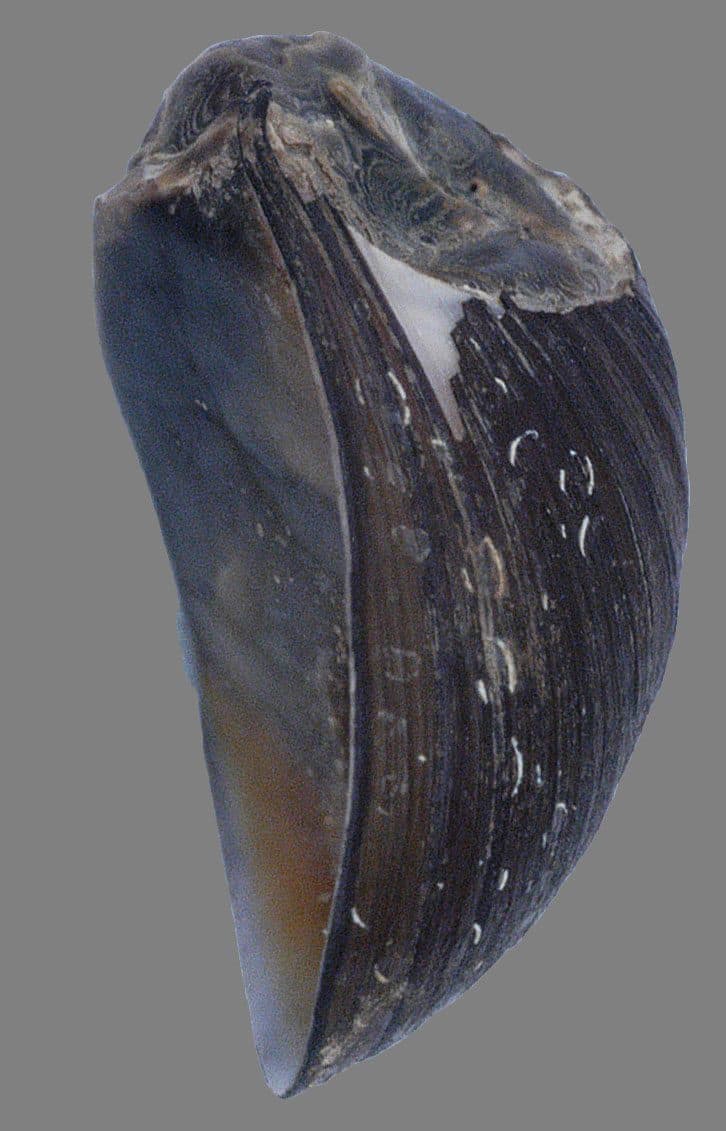
Dark nerite
Neritina pulligera
3 cm
Adult size
80 L
Minimum volume
1
Minimum group
—
Lifespan
Size: shell height.
Water parameters
Understand these valuesHardness (GH): not given by the sources
Carbonate hardness (KH): not given by the sources
- Genus
- Neritina
- Diet
- grazer
- Social life
- alone or in a group
- Activity
- diurnal
- Adult habitat
- fresh water
- Breeding
- larvae in the sea
In the wild
Overview
The dark nerite grazes rocks and submerged roots, often near the surface. Its shell colour varies, which makes identification harder. A trade name such as “algae-eating snail” is not enough to recognise the species.
- Scientific name
- Neritina pulligera (Linnaeus, 1767)
- Classification
- Cycloneritida › Neritidae
- IUCN Red List
- Least concern (LC)
Natural habitat
Tropical Indo-Pacific: Pacific islands, the Philippines, Indonesia, Malaysia, Thailand, northern Australia and Madagascar; reported in Hawaii
Observations (GBIF) and localities Native countries Rivers and lakes
It lives very close to the surface, on rocky areas and submerged roots of rivers, in moderately flowing water that is neutral to alkaline (pH 7 to 8.5). It can briefly leave the water.
Behaviour
Active by day, alone or in groups, it grazes the growth on rocks and roots and withdraws into its shell when threatened.
In the aquarium
Care and setup
Prepare a mature tank offering algae-covered surfaces and a lid to limit escapes. Animals weakened by transport must be able to feed as soon as they arrive.
Feeding
It mainly eats algae; check how much food is really available in the tank.
Breeding
The larvae develop in the sea. Eggs seen in fresh water do not directly produce a new population of snails.
Sources:Fishipedia GBIF · Base map: Natural Earth